If you have ever watched your child stare blankly at a digital screen, feeling that quiet pang of worry about screen fatigue, isolation, or how to truly anchor their social-emotional growth, you are not alone. As a psychiatrist and founder here at TableTopTeaching, I speak with homeschool parents every single week who are searching for something deeper than another worksheet or dry curriculum module. You want education to feel alive. You want your children to thrive, connect, and build genuine resilience.
For years, passionate educators and homeschooling families have whispered about the hidden magic of tabletop role-playing games (RPGs): how rolling a twenty-sided die around a kitchen table can transform shy learners into confident leaders and channel restless energy into laser-focused problem-solving. But for a long time, this was dismissed by skeptics as mere child's play.
Until now.
A landmark evaluation by Imperial College London into the "Young Dragons" Dungeons & Dragons-based programme in London schools has officially changed the conversation. By studying the profound impacts of tabletop gaming on children at risk of exclusion, this research offers rigorous, evidence-based validation for what many of us have known all along: imaginative play is a powerful catalyst for emotional regulation, behavioral growth, and deep human connection.
Let’s unpack what this groundbreaking study reveals, why psychiatric and educational frameworks support these findings, and how you can harness the "Young Dragons" effect right inside your own homeschool.
Inside the Imperial College Study: What the Data Tells Us
Delivered across primary, secondary, and alternative provision schools, the Young Dragons initiative brought structured D&D-style role-playing into educational settings specifically targeting pupils with social, emotional, and mental health (SEMH) needs.
The results of this mixed-methods evaluation were nothing short of eye-opening. While quantitative metrics in short-term pilots often require extended timelines to shift dramatically, the qualitative feedback from educators, support staff, and parents pointed to transformative outcomes:
- Remarkable Improvements in Emotional Regulation: Teachers and parents consistently reported that participating children showed superior anger management, greater emotional control, and an increased capacity to pause before reacting under stress.
- A Landmark Reduction in Suspensions: Most impressively, when researchers matched pre- and after-intervention records, they observed a significant decrease in disciplinary suspensions among participating pupils.
- Enhanced Social Awareness and Communication: Children who previously struggled with verbal expression found their voice through their character avatars, building stronger, more empathetic peer relationships.
As a psychiatrist, this makes profound clinical sense. Tabletop role-playing games create a structured psychological safety net. When children navigate high-stakes scenarios through a fantasy persona: negotiating with a merchant, cooperating to cross a chasm, or resolving an in-game dispute: they are actively rehearsing emotional regulation and impulse control in a low-threat environment.
Translating the Research: Why RPGs Work Wonders in Your Homeschool
You might be wondering: This is wonderful for institutional schools, but how does a London research study apply to my kitchen table or living room floor?
Homeschooling offers the ultimate environment to amplify these exact benefits. Unlike crowded classrooms where teachers must manage dozens of personalities, your homeschool allows you to tailor imaginative play directly to your child's developmental rhythm.
When you introduce structured RPG learning guides into your core routine, you aren’t just playing a game; you are activating multiple developmental layers simultaneously:
- Low-Stakes Emotional Rehearsal: In real life, emotional failure feels devastating. In an RPG, when a character fails a skill check, it is part of the story arc. Children learn how to process disappointment, adapt their strategies, and bounce back without enduring real-world social fallout.
- Intrinsic Motivation for Academics: Suddenly, reading comprehension, fractions, probability, and historical context are no longer abstract hurdles. They are the exact tools your child needs to decipher ancient runes, calculate damage points, or understand the political alliances of a fictional kingdom.
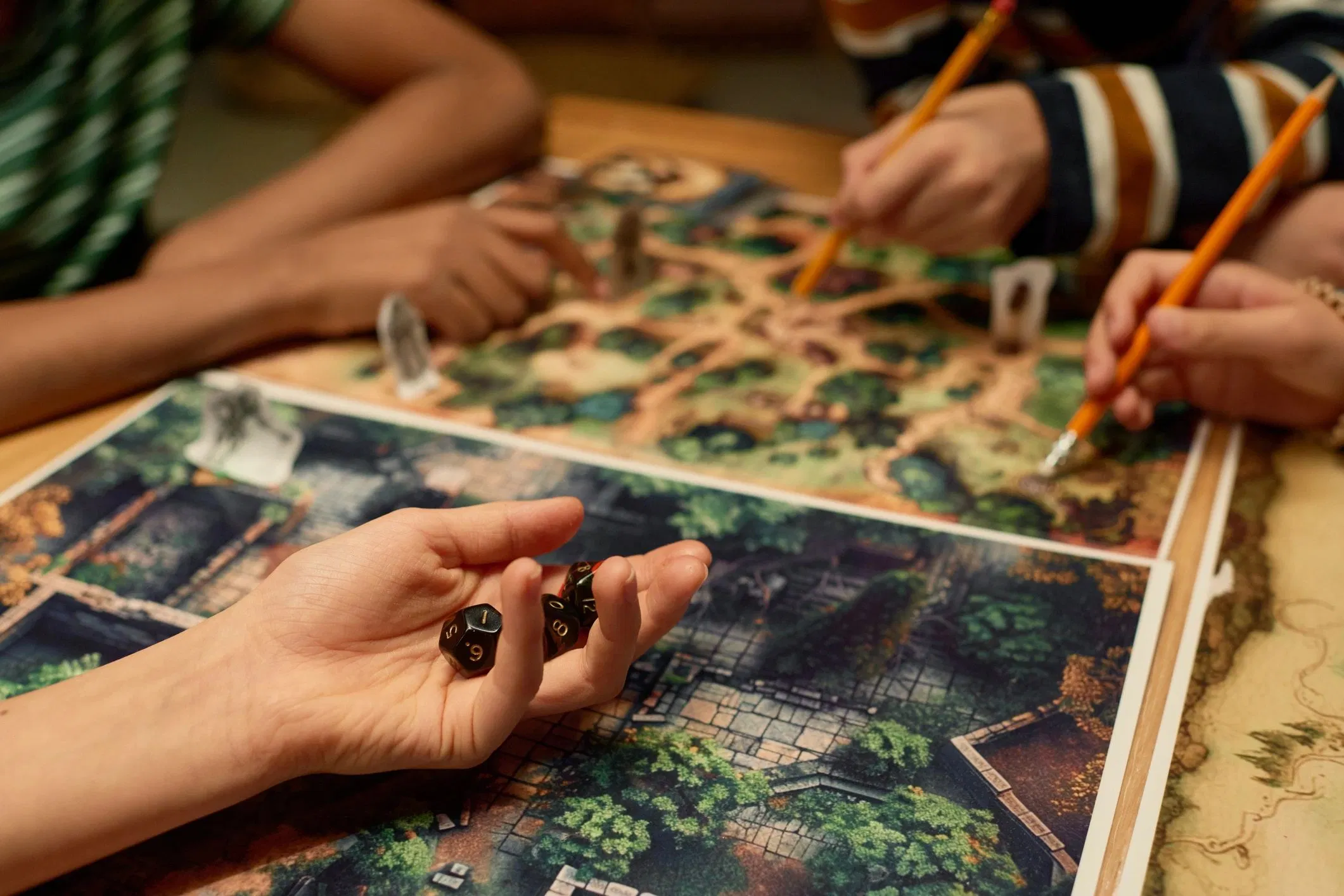
- Deep, Screen-Light Family Connection: In an era dominated by solitary screen time, a tabletop game gathers everyone around physical materials: paper, pencils, polyhedral dice, and tactile tokens: fostering genuine eye contact and shared laughter.

The Four Pillars of RPG-Based Social-Emotional Growth
The Imperial College findings align directly with the core competencies of Social and Emotional Learning (SEL). Here is how tabletop role-playing naturally cultivates these four essential pillars in children:
1. Self-Management
During a game session, children must manage their excitement, wait their turn during complex combat rounds, and regulate their frustration when dice rolls don't go their way. This builds executive function and patience organically.
2. Relationship Skills
An RPG is fundamentally cooperative. No single player can survive a dungeon alone. Children learn to listen actively, support their siblings or peers, coordinate strategies, and celebrate collective victories.
3. Responsible Decision-Making
Every narrative choice carries weight. Should the party rescue the trapped villagers or pursue the fleeing goblin? Children weigh ethical dilemmas, evaluate consequences, and practice moral reasoning in real-time.
4. Social Awareness
Stepping into the shoes of an elven ranger, a dwarven cleric, or a clever bard requires radical empathy. Children must consider perspectives vastly different from their own, deepening their understanding of diverse motivations and feelings.
How to Bring the 'Young Dragons' Magic Into Your Living Room
You do not need a degree in game design or thousands of dollars in miniatures to recreate these benefits at home. Getting started is simpler than you think:
- Start with Simple Rules: Choose age-appropriate, rules-light introductory systems designed specifically for families and young learners.
- Focus on Story Over Statistics: Keep the emphasis on creative problem-solving and character interactions rather than heavy rulebooks. Ask open-ended questions like, "How does your character react when the bridge starts to collapse?"
- Embrace Collaborative Worldbuilding: Let your children help shape the world. Ask them to name the tavern, design the local town guard, or invent the riddle guarding the ancient temple.
- Reflect After the Game: Take five minutes after a session to ask gentle debrief questions: "What was the hardest choice your character had to make today?" or "How did the team work together when things looked tough?"

To dive deeper into setting up your first family session, explore our practical guide on how to integrate tabletop RPGs with your core homeschool curriculum.
Frequently Asked Questions
Is D&D or tabletop role-playing too complex for younger children?
Not at all! While traditional rulebooks can be dense, family-focused tabletop systems strip away the complicated arithmetic and focus entirely on imaginative storytelling, simple choices, and cooperative dice rolling. Even 6- and 7-year-olds thrive when guided through simple, structured adventures.
How do I balance RPG sessions with core academic subjects like math and reading?
Think of tabletop gaming as the glue that binds your core subjects together. Character creation builds writing and vocabulary skills; managing inventory and rolling dice reinforces arithmetic and probability; mapping out dungeons introduces geography and spatial reasoning. You can easily replace a traditional Friday afternoon review with an epic campaign session!
What if my child is shy or hesitant to role-play?
That is completely normal. Many children start simply by observing or rolling dice for an older sibling or parent. Role-playing is a journey, not a performance. Give them space to find their voice through their character sheet at their own comfortable pace.
Empower Your Homeschool Journey Today
The research is clear: when we combine imaginative play with structured guidance, we give our children extraordinary tools to regulate their emotions, resolve conflicts, and approach learning with fearless curiosity. You don't have to choose between academic rigor and emotional well-being: you can weave them together into an unforgettable adventure.
Ready to bring the transformative power of tabletop learning into your home? Visit our Start Here page to explore evidence-based guides, practical family activities, and community resources designed to help you and your children thrive.
Let the adventure begin!
Leave a Reply