You know that mid-morning slump. The one where the math worksheets start to feel like lead, and the history textbook seems to have more dust than interesting facts. You’ve felt the frustration of watching your child’s eyes glaze over during a lesson that should be exciting, and you’ve wondered if there’s a better way to bridge the gap between "schooling" and "learning."
What if you could breathe life into those dry concepts? What if you could transform your dining room table into a sprawling map of ancient civilizations, where every calculation matters because a dragon’s fire depends on it, and every written word is a clue in a high-stakes mystery?
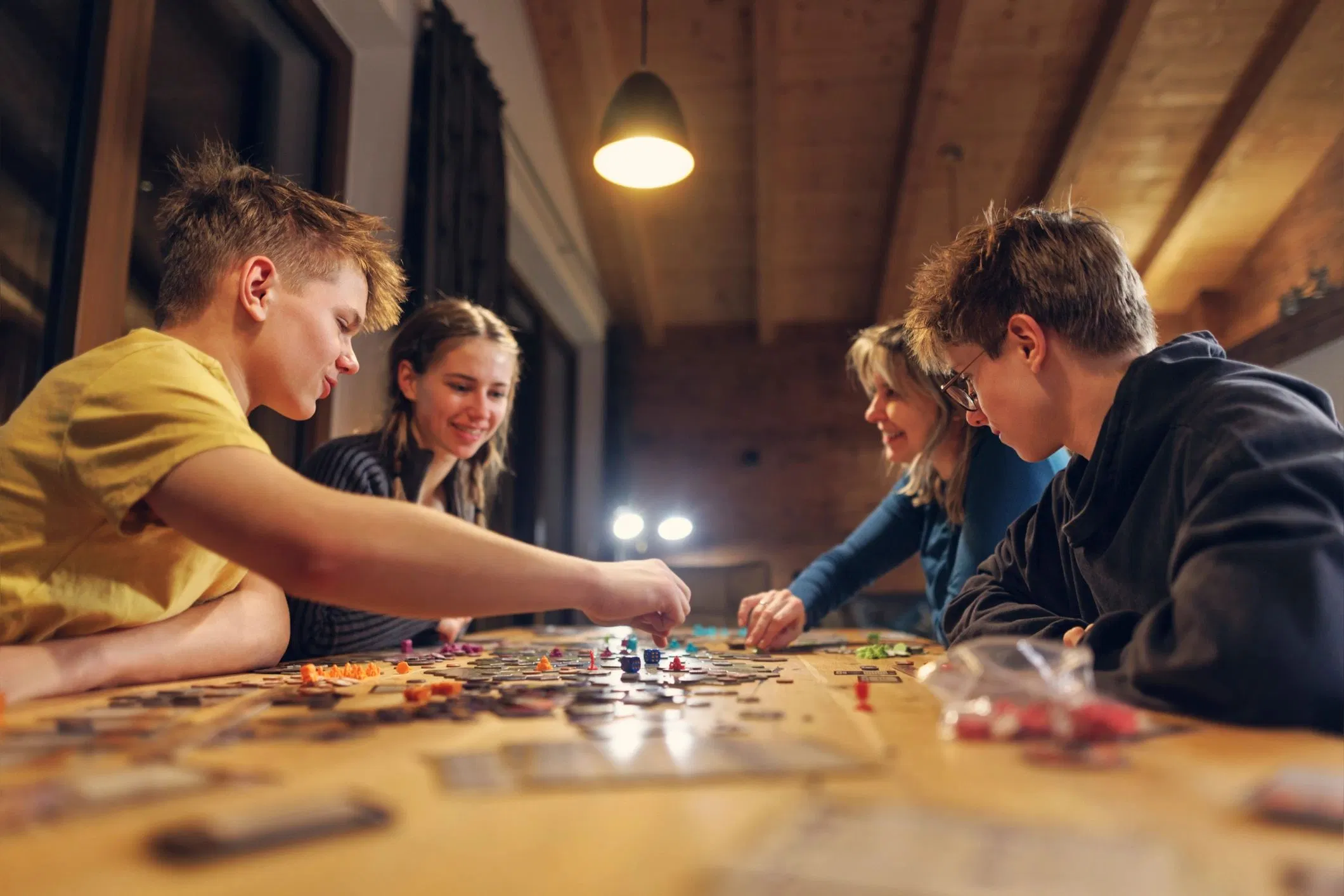
This isn't just a daydream. This is the power of integrating Tabletop Role-Playing Games (RPGs) into your homeschool curriculum. As a psychiatrist and founder of TableTopTeaching, I’ve seen firsthand how these "screen-light" adventures don't just teach academic subjects, they flourish the heart and mind simultaneously.
The Alchemy of Math: Beyond the Calculation
For many children, math feels like a series of abstract rules applied to meaningless numbers. When you introduce RPGs, you harness the power of probability and arithmetic by making them the very engine of the story.
Sharpening Mental Arithmetic
In a game like Dungeons & Dragons or our simplified systems, numbers are constant companions. Every time your child rolls a die, they are performing a "needs-to-know" calculation.
- Addition & Subtraction: "I rolled a 14, plus my 3 strength bonus, minus the 2 penalty for being tired… does that hit the armor class of 15?"
- Multiplication: "My fireball does 4d6 damage. I rolled two 5s and two 4s, what’s the total?"
These aren't just drills; they are critical moments in a narrative. When the math is the only thing standing between a hero and their goal, the brain engages at a much deeper level. You are moving from passive consumption to active application.
Mastering Probability and Risk
One of the most complex concepts to teach in middle school is probability. RPGs make this tangible. When your child looks at a twenty-sided die (a d20), they are looking at a 5% chance per face.
- Strategic Decision Making: "The dungeon master says I need a 15 to jump the chasm. I only have a 30% chance of success. Is it worth the risk, or should I use my rope?"
- Data Analysis: Over several sessions, kids begin to understand the "bell curve" of rolling two six-sided dice versus the flat distribution of a d20.
By using these critical thinking mechanics, you aren't just teaching them to solve for x; you are teaching them to solve for life.

Weaving Worlds: ELA as a Living Narrative
English Language Arts (ELA) often gets bogged down in grammar diagrams and forced book reports. Tabletop RPGs transform literacy into a tool for survival and expression.
Authentic Writing and Vocabulary
In a campaign, the "assignment" is replaced by the "quest log." Instead of a five-paragraph essay on a book they didn't choose, ask your child to write:
- Character Backstories: This requires narrative structure, character arc development, and descriptive language.
- In-World Correspondence: Writing a formal letter to a king or a frantic note to a teammate builds tone and voice.
- Session Recaps: We call this the "Science of the Recap." Asking your child to summarize the previous session is a powerful form of retrieval practice that strengthens long-term memory and reading comprehension.
The Power of the Spoken Word
RPG sessions are, at their core, collaborative storytelling. Your child is practicing oral communication, persuasive speech, and active listening for hours at a time. They learn to adapt their vocabulary to match their character, perhaps using more formal language for a wizard or rugged, punchy sentences for a warrior.
Living History: Social Studies and World-Building
History can often feel like a list of dates to memorize. But when you use RPGs to teach history, your children aren't just reading about the past, they are walking through it.
Cultural Research and Civics
Imagine your current history unit is on Ancient Rome. Instead of a test, your child’s character arrives at the gates of a city modeled after Rome.
- Geography: They must navigate a map, understanding how rivers and mountains affect trade and defense.
- Sociology: They interact with NPCs (Non-Player Characters) who explain the laws, class structures, and religious beliefs of the time.
- Civics: They might be tasked with resolving a dispute between two factions, requiring them to understand the political nuances of the era.
This "learning alongside" approach allows you to explore complex social structures through the safe lens of a game. It turns a static subject into a vibrant, 3D world they can explore.

The Heart of the Game: Social-Emotional Learning (SEL)
As a psychiatrist, this is where I see the most profound impact. While you are hitting your academic benchmarks, you are also building family connections that last a lifetime.
RPGs provide a safe "sandbox" for children to practice:
- Empathy: What does it feel like to be someone else? How would my character react to this injustice?
- Conflict Resolution: When the party disagrees on which path to take, how do we negotiate without ruining the fun?
- Resilience: Sometimes the dice don't go your way. Learning to fail forward in a game builds the emotional regulation needed to handle setbacks in the real world.
Our resources at TableTopTeaching are specifically designed to build these social skills while keeping the focus on screen-light, tactile play.
How to Start Your Adventure Today
You don't need to be a professional "Dungeon Master" to begin. You just need a willing spirit and a few basic tools.
- Choose Your System: Start with a "rules-light" system if you're nervous. You can find many best tabletop RPGs for homeschool listed on our site.
- Define Your Learning Objective: Are you focusing on math today? Ensure the session involves lots of shop-keeping (arithmetic) and trap-disarming (probability). Is it ELA? Focus on a mystery that requires reading ancient scrolls.
- Gather Your Tools: Get some dice, some paper, and a pencil. Keep it tactile. Avoid the temptation to use digital tools; the "screen-light" aspect is what fosters the deep focus and connection.
- Follow a Roadmap: If you feel overwhelmed, use a structured guide like our TEFA 2026 Roadmap to integrate these activities step-by-step.

Frequently Asked Questions
"Isn't this just 'playing'? Does it really count as school?"
Absolutely. Research shows that play-based learning leads to higher retention rates and better engagement. When a child is emotionally invested in a story, their brain is primed for learning. Think of it as "stealth learning", they are working harder than they would on a worksheet, but because they are having fun, the "work" feels like an adventure.
"What if I don't know the rules?"
That’s the best part! You can learn alongside your children. This positions you as a collaborator rather than an unreachable expert, which strengthens your bond. The "rules" are just a framework; the story is yours to create.
"My child struggles with sitting still. Is this right for them?"
Yes! RPGs are highly engaging and allow for physical components like miniatures, maps, and rolling dice. It provides a structured way to be active while remaining focused on the task at hand.
Bridge the Gap to a New Way of Learning
You have the power to transform your homeschool from a series of tasks into a shared journey. You can move away from the stress of "getting through the curriculum" and move toward the joy of discovering it together.
Ready to take the first step? Check out our TTT Playbook for practical, evidence-based activities that will turn your next lesson into an unforgettable adventure. Your family’s greatest story is just one dice roll away. Adventure awaits: grab your dice and let’s begin!
Leave a Reply