
You've seen it before. The worksheet is half-finished. Your kid, bright, curious, capable, sits at the table, staring at the same math problem they solved yesterday. And the day before. And last week.
You ask them to explain their answer. They shrug. "I don't remember."
It's not defiance. It's not laziness. It's the reality of how most traditional learning environments are structured: isolated practice, decontextualized problems, and assessment that feels disconnected from meaning. The knowledge doesn't stick because the learning never required them to use it in a way that mattered.
This is the daily friction most families experience. The homework battles. The tutoring sessions that feel like pulling teeth. The growing sense that more exposure, more repetition, more worksheets aren't actually solving the problem.
What if the issue isn't the child, but the delivery system?
The Experiential System: What Game-Based Learning Actually Means
Let's start by clearing up a common misconception. When we say "game-based learning," we're not talking about gamification, the practice of bolting points, badges, and leaderboards onto traditional curricula to make kids more compliant.
Gamification is behavioral scaffolding. It's extrinsic motivation dressed up in bright colors. And here's the test: if you remove the points and the learning stops, it was never really learning. It was operant conditioning.
Game-based learning is something else entirely. It's a system of play where choices have consequences, where students must make decisions based on incomplete information, retrieve prior knowledge under pressure, and experience feedback loops that reinforce understanding through meaningful action.
Research on retrieval practice and desirable difficulties suggests that learning is most durable when it requires effortful cognitive processing (Bjork & Bjork, 2011). Tabletop role-playing games naturally create these conditions. A child solving for the area of a room isn't completing a worksheet, they're deciding whether their character can fit through a doorway while water is rising. The math becomes necessary, not ornamental.

The Table Atoms: Four Domains Every Encounter Can Train
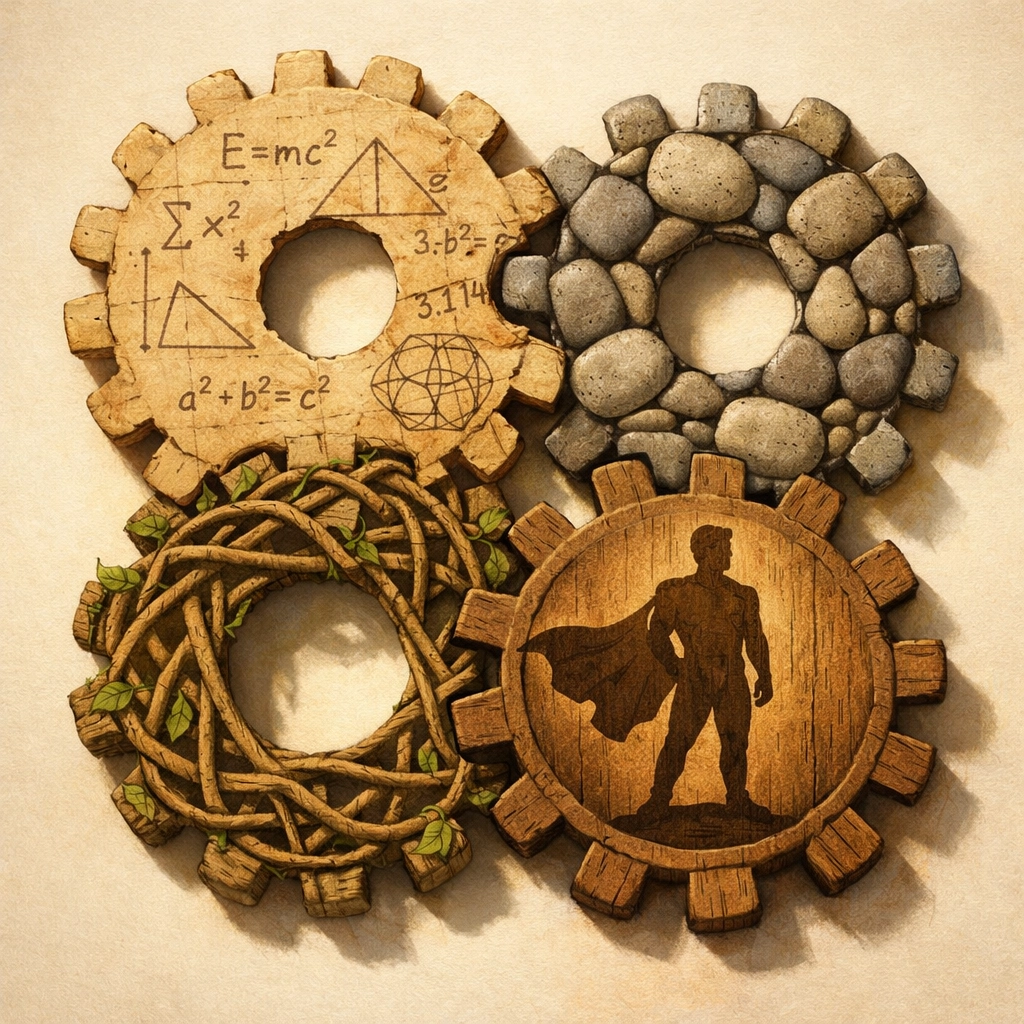
The Tabletop Teaching Playbook is designed to support learning across four interconnected domains we call the Table Atoms. Every scene, quest, or encounter you design can target one or more of these:
1. Academic Literacy
This is the content knowledge, math, reading comprehension, historical reasoning, scientific method. But unlike isolated skill drills, academic literacy in this system is always embedded in context. Students aren't solving for x because the worksheet says so. They're solving for x because the bridge won't hold without the correct calculation.
2. Social-Emotional Learning (SEL)
Collaborative problem-solving, perspective-taking, emotional regulation under uncertainty, these aren't separate "soft skills." They're cognitive demands that arise naturally when students work together to navigate complex scenarios. Research on cooperative learning indicates that structured group problem-solving can improve both academic outcomes and social competence (Johnson & Johnson, 2009).
3. Projective Identity
This is the role the child inhabits at the table. Not "student," but investigator, builder, healer, strategist. Projective identity allows learners to take intellectual risks they might avoid in traditional settings because failure isn't personal, it's part of the character's journey. This concept, drawn from game studies scholar James Paul Gee, aims to create psychological safety for exploration (Gee, 2003).
4. Systems Thinking
The ability to see relationships, feedback loops, and unintended consequences. In a tabletop scenario, pulling one lever affects three other mechanisms. Helping one NPC might alienate another. Students begin to think ecologically, to see learning as interconnected rather than siloed.
Each Table Atom serves a purpose, and the beauty of the system is that you don't need to target all four in every encounter. Pick one or two per scene. Over the course of a campaign, students will cycle through all of them naturally.
The GM Role: Building Knowledge with 'Yes, And' and 'Yes, But'
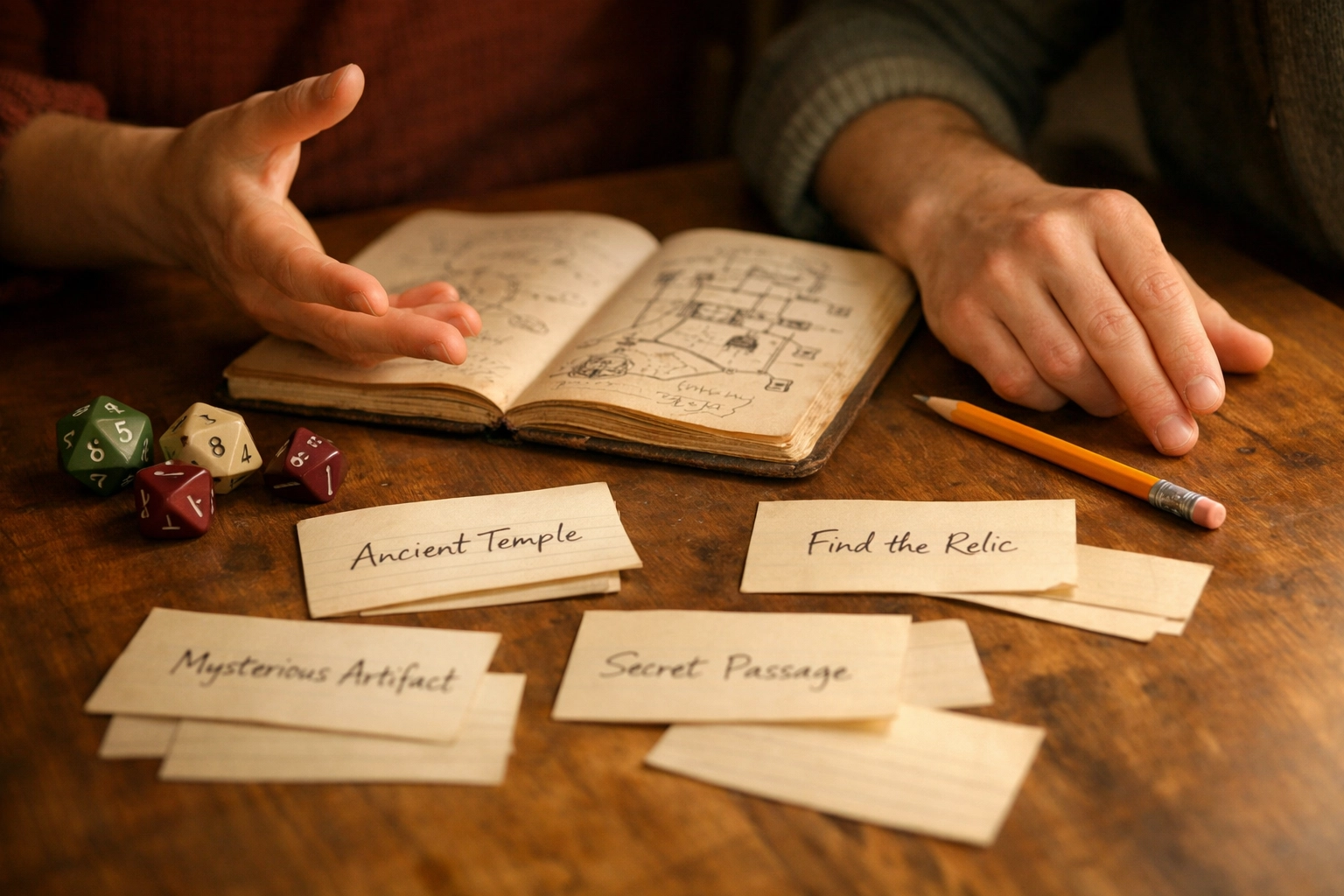
Here's where the system diverges sharply from traditional teaching. The adult at the table isn't "the boss." They're the Game Master (GM), a role borrowed from tabletop gaming but adapted for learning contexts.
The GM facilitates, complicates, and rewards. Three core tools make this work:
"Yes, And" builds momentum. When a student proposes a creative solution, the GM doesn't shut it down, they extend it. "Yes, you can use the rope to cross the chasm, and you'll need to calculate how much weight it can hold."
"Yes, But" adds constraint without negation. "Yes, you can attempt that spell, but it will cost you half your remaining energy, and you'll need to explain the chemical reaction that powers it."
The Rule of Cool rewards ingenuity. If a student proposes something clever, narratively interesting, and educationally sound, the GM allows it, even if it wasn't in the original plan. This isn't permissiveness. It's recognizing that learning happens when students see their reasoning valued.
This approach is rooted in constructivist learning theory, which suggests that knowledge is built through active engagement and social negotiation, not passive reception (Vygotsky, 1978). The GM creates the conditions for that construction.
Mapping: Campaigns, Arcs, and Quests
One of the most common questions we hear: How do I plan this without it taking over my life?
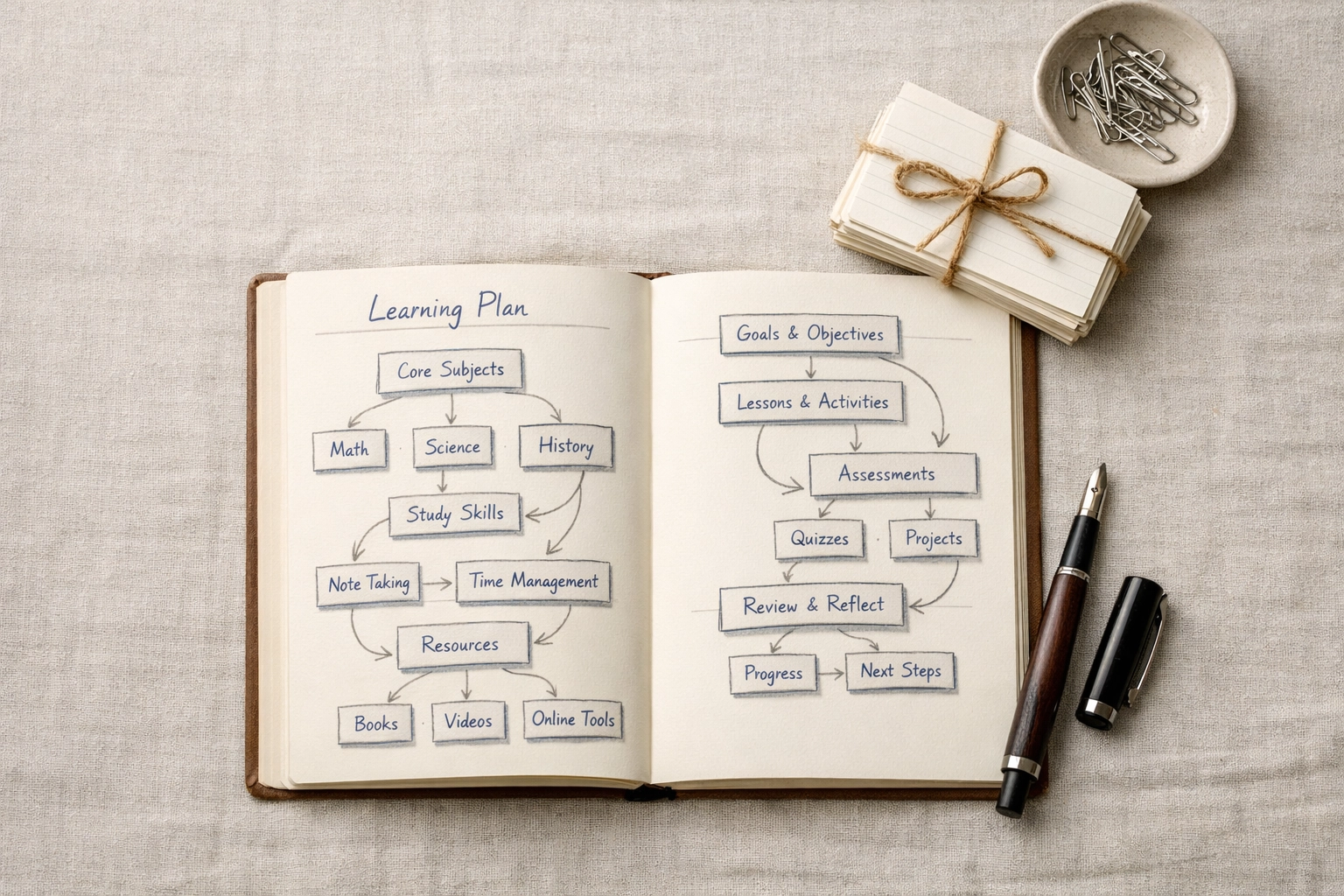
The answer is structural clarity. The Tabletop Teaching Playbook maps directly onto traditional curriculum planning:
- Campaign = Unit of Study. A semester-long exploration of fractions, or the Revolutionary War, or ecosystems.
- Arc = Chapter. A multi-session storyline that explores one major concept or skill cluster within the campaign.
- Quest = Assessment. A discrete challenge that allows students to demonstrate understanding. Not a test. A scenario with stakes.
For example, a fractions campaign might include an arc about comparing quantities, with individual quests like "divide the treasure fairly among the adventuring party" or "measure ingredients for a potion that requires precise ratios."
This isn't busywork dressed up in fantasy language. It's retrieval practice, spaced repetition, and transfer of learning, all research-backed strategies for long-term retention (Roediger & Butler, 2011), embedded in a structure that feels coherent to both the adult and the child.
Safety First: The Foundation for Risk-Taking
None of this works if the table doesn't feel safe.
We're not talking about physical safety, though that matters too. We're talking about psychological safety, the conditions that allow a learner to make mistakes, ask questions, and propose ideas without fear of judgment or ridicule.
Every table needs co-created norms. Before the first session, the group agrees on how they'll treat each other, what topics are off-limits, and how they'll handle moments of discomfort.
We recommend simple, portable safety tools borrowed from the broader tabletop gaming community:
- The X-Card: Anyone can tap out of a scene, no questions asked, if it's making them uncomfortable.
- Lines and Veils: "Lines" are hard boundaries (topics we won't include). "Veils" are things that can happen off-screen (we acknowledge them, but don't narrate them in detail).
- Pause/Rewind: If something goes wrong, anyone can pause the game, discuss what happened, and rewind to try again.
These aren't coddling. They're the same risk-management strategies used in improv theater, therapeutic role-play, and high-stakes team simulations. Research on learning environments indicates that students take more intellectual risks, and therefore learn more deeply, when they trust the social structure around them (Dweck, 2006).
The Turn: This Isn't About Making Learning Fun
Here's the realization that often surprises people: the goal of the Tabletop Teaching Playbook isn't to make learning fun.
Fun is fine. Fun is welcome. But fun is a byproduct, not the mechanism.
The mechanism is cognitive necessity. When a student must retrieve knowledge, apply it under constraint, and experience the consequences of their reasoning in real time, learning happens whether or not they're smiling.
Sometimes the table is fun. Sometimes it's tense, challenging, frustrating in the way that good problems are frustrating. Sometimes students argue about strategy, negotiate solutions, or sit in silence while they think.
That's not a bug. That's the system working.
Traditional education often conflates engagement with entertainment. The Tabletop Teaching Playbook aims to create engagement through meaningful challenge, problems worth solving, choices that matter, and feedback that's immediate and informative.
What This Looks Like in Practice
Let's bring this down to earth. You're working on multiplication with a third-grader who has memorized the times tables but can't apply them flexibly.
In a traditional setting, you'd assign more worksheets. More timed drills. More repetition.
In the Tabletop Teaching Playbook, you might create a quest: "The village blacksmith needs 6 swords, each requiring 8 iron ingots. How many ingots total? You have 50 in the storehouse. Is that enough? If not, how many more do you need to mine?"
The child isn't doing multiplication because you told them to. They're doing it because the village needs weapons and the math determines whether the quest succeeds.
Then you complicate it. "Yes, you can mine more iron, but it will take three days, and the enemy army arrives in five. What's your backup plan?"
Now they're thinking about time constraints, resource allocation, and alternative strategies: all while practicing the core skill.
This is the experiential system in action. Academic literacy (multiplication), systems thinking (resource management), and projective identity (the heroic role of village protector) woven together in a single encounter.
Moving Forward: The Five Supporting Posts
This cornerstone post introduces the framework. Over the coming weeks, we'll break down each component in detail:
- Game-Based Learning vs. Gamification (a deeper dive into what makes choices meaningful)
- The Table Atoms (how to design encounters that target specific domains)
- The GM Role (scripts, language, and facilitation techniques)
- Safety First (printable tools and session-zero templates)
- The Encounter Template (a ready-to-use structure for building your own quests)
Each post will give you practical, immediately usable tools. Because the goal isn't to add more to your plate. It's to give you a system that reduces the daily friction: for you and for the learners you're supporting.
The Tabletop Teaching Playbook is designed to support durable learning, not compliance. It's built on research-backed principles of retrieval, spacing, interleaving, and transfer. And it's structured to fit into the time and energy you actually have, not the idealized version of homeschooling or tutoring that exists only in someone's Instagram feed.
You don't need to be an expert. You don't need a teaching degree or a background in game design. You just need to be willing to sit across the table, ask "what do you do?", and let the learning unfold from there.
Adult/Guardian supervision is required. Use age-appropriate content and follow family/school policies. We recommend safety tools like Pause/X-Card. Educational guidance only; not medical advice.
References
Bjork, R. A., & Bjork, E. L. (2011). Making things hard on yourself, but in a good way: Creating desirable difficulties to enhance learning. Psychology and the Real World: Essays Illustrating Fundamental Contributions to Society, 2, 59-68.
Dweck, C. S. (2006). Mindset: The new psychology of success. Random House.
Gee, J. P. (2003). What video games have to teach us about learning and literacy. Palgrave Macmillan.
Johnson, D. W., & Johnson, R. T. (2009). An educational psychology success story: Social interdependence theory and cooperative learning. Educational Researcher, 38(5), 365-379.
Roediger, H. L., & Butler, A. C. (2011). The critical role of retrieval practice in long-term retention. Trends in Cognitive Sciences, 15(1), 20-27.
Vygotsky, L. S. (1978). Mind in society: The development of higher psychological processes. Harvard University Press.