
Category: Micro-Adventures

  • Problem-Solving & Analytical Skills

    Problem-Solving & Analytical Skills

    You’ve likely faced moments when a challenge seemed insurmountable until you broke it down systematically. That shift from confusion to clarity isn’t luck—it’s the result of honing specific analytical abilities that separate effective problem-solvers from those who simply react. Whether you’re navigating workplace obstacles or personal decisions, these skills determine how quickly you’ll move from identifying what’s wrong to implementing what works.

    The 5 Core Components of Problem-Solving and Analytical Skills

    While many professionals rush to solve problems as quickly as possible, truly effective problem-solvers follow a structured approach that transforms challenges into sustainable solutions.

    The framework consists of five essential components. First, you’ll focus on defining the problem by distinguishing facts from opinions and gathering qualitative and quantitative data from stakeholders.

    Next, you’ll conduct root cause analysis using techniques like the 5 Whys and 5W2H framework to identify underlying issues.

    Third, you’ll engage in generating potential solutions through creative thinking and evaluation.

    Fourth, you’ll focus on implementing chosen solutions using decision-making tools.

    Finally, you’ll prioritize sustaining results through continuous monitoring and feedback mechanisms, ensuring your solutions remain effective and aligned with organizational goals over time.

    How to Define Problems and Identify Root Causes

    Before implementing any solution, you must accurately identify what you’re actually trying to solve.

    To define problems effectively, distinguish facts from opinions and involve stakeholders for comprehensive understanding. The problem-solving process requires you to analyze root causes using techniques like the 5 Whys, digging deeper beyond surface-level symptoms that only yield temporary fixes.

    Conduct a gemba review to document current processes, gathering both qualitative and quantitative data by addressing What, Where, When, How, Who, and Why.

    Prioritize identified root causes for investigation, ensuring your collected information validates these causes. Collaborate with team members during analysis to thoroughly understand underlying issues and document findings for future reference.

    This systematic approach ensures you develop effective solutions to problems rather than merely treating symptoms.

    Proven Techniques for Developing Strong Solutions

    Once you’ve identified the root cause of a problem, you’re ready to develop solutions that address it effectively. Start by brainstorming multiple possible solutions using proven problem-solving techniques. This creative approach generates diverse options you can evaluate systematically.

    Apply the DMAIC framework to structure your improvement process from definition through control, ensuring sustained results.

    Engage employees and stakeholders throughout solution development. Their involvement increases buy-in and uncovers practical insights you might otherwise miss.

    Use decision-making tools to assess each option’s feasibility before implementation.

    Embrace continuous improvement by adopting the PDCA cycle. Monitor your solutions regularly, evaluate their effectiveness, and refine them as needed.

    This iterative approach ensures your solutions remain relevant and impactful over time, addressing both immediate concerns and evolving challenges.

    Common Barriers That Sabotage Problem-Solving

    Even the most skilled problem solvers encounter cognitive barriers that derail their analytical process.

    Confirmation bias leads you to favor information supporting your existing beliefs while dismissing contradictory evidence, resulting in flawed conclusions.

    Mental set traps you in familiar problem-solving patterns, preventing exploration of innovative alternatives.

    Functional fixedness restricts your perception of objects and concepts to their traditional uses, blocking creative applications.

    You’ll also face unnecessary constraints that impose artificial limitations on potential solutions.

    Additionally, irrelevant information distracts you from core issues, causing confusion and poor decision-making.

    Recognizing these barriers is essential for maintaining analytical effectiveness.

    Why Data-Driven Analysis Beats Intuition Every Time

    While intuition feels comfortable and familiar, data-driven analysis delivers measurably superior results across every business metric. When you’re solving problems, relying on objective statistics rather than gut feelings reduces bias and enables smarter choices.

    Companies using data-driven analysis are 23 times more likely to acquire customers and 19 times more likely to be profitable than competitors who depend on intuition alone.

    You’ll identify patterns and trends that intuition misses, leading to more effective strategies. Decision-making processes like A/B testing systematically validate your hypotheses against empirical evidence, improving outcomes while reducing costs.

    This approach helps you discover the optimal solution to a problem through measurable metrics rather than personal experiences. Organizations leveraging analytics achieve 5-6% productivity increases, proving data consistently outperforms instinct.

    When to Use Advanced Problem-Solving Frameworks?

    Data-driven analysis provides the foundation for smart decisions, but certain problems demand structured methodologies that go beyond standard analytics. You’ll need advanced frameworks when tackling complex issues that involve multiple stakeholders or require innovative solutions.

    TRIZ and Design Thinking excel in multidisciplinary environments where user needs intersect with business objectives.

    For manufacturing challenges, the 8D model offers systematic root cause analysis and corrective action to eliminate recurring defects.

    When you’re focused on continuous improvement, the PDCA cycle delivers an iterative approach that tracks progress and sustains results over time.

    The 5 Whys technique proves invaluable when surface-level symptoms mask deeper problems.

    How to Build Problem-Solving Skills Through Deliberate Practice

    Three core principles distinguish deliberate practice from routine problem-solving: intentionality, feedback integration, and progressive difficulty.

    You’ll build stronger skills by setting specific goals for each session—whether that’s mastering a particular problem type or exploring multiple solution pathways. The process requires analyzing your past attempts to identify patterns in your strengths and weaknesses.

    Challenge yourself with varied, increasingly complex problems that push your cognitive boundaries. This stimulates mental flexibility and prevents stagnation.

    Don’t practice in isolation—collaborate with others to exchange strategies and perspectives. Their approaches might reveal solution methods you hadn’t considered.

    After each session, reflect on what worked and what didn’t. This analyzing phase transforms raw experience into actionable insights, helping you solve future challenges more effectively.

    Frequently Asked Questions

    What Is the Definition of Problem-Solving?

    You’ll define problem-solving as the process of identifying obstacles, diagnosing their root causes, implementing effective solutions, and maintaining results to achieve your desired goals while continuously improving your approaches through systematic methodologies.

    What Are the 7 Steps of Problem-Solving?

    You’ll define the problem, clarify it, define goals, identify root causes, develop an action plan, implement that plan, and monitor results. These steps help you systematically solve problems and ensure your solutions work effectively.

    What Are the 4 Problem-Solving Skills?

    You’ll need four essential problem-solving skills: critical thinking to assess situations logically, creativity to generate innovative solutions, analytical abilities to evaluate information systematically, and collaboration skills to leverage diverse perspectives when working with others.

    Is Problem-Solving One Word or Two Words?

    You’ll most commonly see “problem-solving” written as one hyphenated word, especially in formal writing. However, you can use “problem solving” as two words when you’re describing the action rather than using it as a compound adjective.

    Conclusion

    You’ve now got the blueprint for tackling complex challenges head-on. Start by defining problems clearly, digging into root causes, and generating creative solutions backed by data. Don’t let common barriers derail your progress—use proven frameworks when you’re stuck. Remember, these skills aren’t innate; they’re built through deliberate practice. Apply what you’ve learned consistently, seek feedback, and you’ll transform how you approach problems in every aspect of your life.
  • Fostering Creativity Through RPGs

    Fostering Creativity Through RPGs

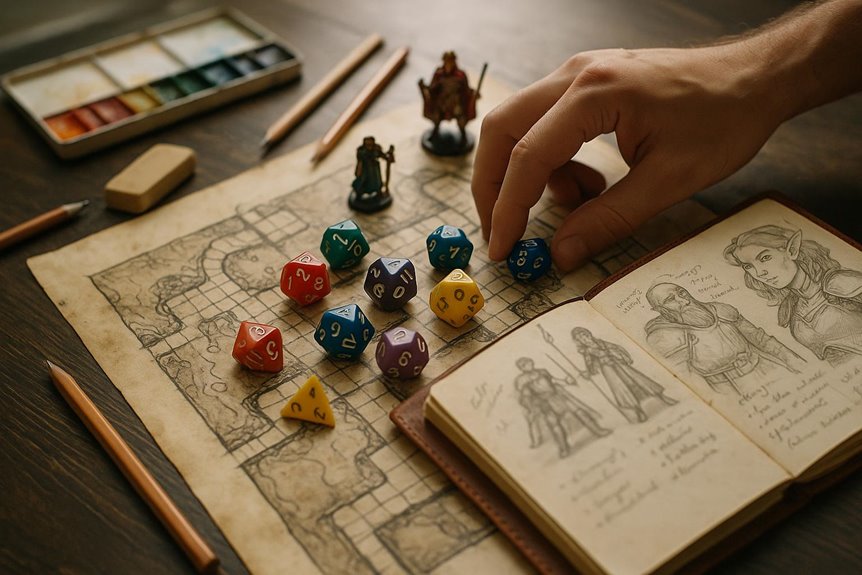
    You’ve probably felt that creative spark when you’re piecing together a character’s backstory or talking your way out of a dragon’s lair. RPGs don’t just entertain—they’re workshops for your imagination, pushing you to think on your feet and collaborate in ways traditional creative outlets can’t match. But what makes these games so effective at unlocking creative potential, and how can you harness that power whether you’re a veteran player or just curious about starting?

    How RPGs Activate Imagination Through Player Choice and Agency

    Because traditional storytelling casts audiences as passive observers, role-playing games revolutionize the creative experience by placing you directly in control of the narrative.

    You create unique characters with distinct attributes and moral alignments, establishing immediate personal investment in the story’s outcome. This agency transforms you from spectator to architect.

    Your creativity flourishes through meaningful player choice. Each decision—whether navigating moral dilemmas or selecting unconventional problem-solving approaches—shapes the plot’s direction.

    You’re not following predetermined paths; you’re forging them. The freedom to leverage your character’s abilities in innovative ways stimulates imaginative thinking.

    You explore different identities and perspectives, experimenting with solutions that reflect your creative vision. This interactive framework doesn’t just entertain—it actively develops your creative capacity through engaged participation.

    Why Character Creation Teaches Self-Expression and Identity Exploration

    When you design a character from scratch—selecting their appearance, personality traits, moral compass, and backstory—you’re engaging in authentic self-expression.

    Character creation provides a safe space where you can explore different facets of your identity without real-world consequences. You might embody a morally ambiguous rogue when you’re typically law-abiding, or create a charismatic leader when you’re naturally reserved.

    This identity exploration encourages critical thinking as you consider how your character’s values influence their decisions. Each choice reveals something about your own perspectives and beliefs.

    Through developing your avatar’s personality and watching them evolve through gameplay, you gain deeper insights into your own potentialities. You’ll discover hidden aspects of yourself while simultaneously developing empathy by inhabiting perspectives vastly different from your own.

    How Collaborative Storytelling Builds Narrative and Communication Skills

    Character creation provides the foundation for self-discovery, but RPGs truly come alive when players collaborate to weave stories together.

    You’ll develop communication skills as you articulate ideas and express emotions during gameplay. When brainstorming story arcs and character dynamics with others, you’re practicing teamwork and creative thinking simultaneously.

    Role-playing different perspectives strengthens your empathy and helps you understand diverse viewpoints. You’ll navigate challenges through collaborative problem-solving, requiring constant interaction and shared decision-making.

    This collaboration naturally improves conflict resolution abilities as you work through disagreements about narrative direction.

    The interactive nature of collaborative storytelling creates lasting social bonds. You’ll connect deeply with fellow players through shared experiences, celebrating victories and overcoming obstacles together while continuously refining your narrative development and interpersonal abilities.

    Problem-Solving in Fantasy Settings That Translate to Real Life

    As you face mysterious puzzles and tactical combat scenarios in fantasy worlds, you’re actually training your brain to tackle real-world challenges with fresh perspective. RPGs demand strategic thinking as you navigate complex situations under pressure, forcing you to analyze problems from multiple angles.

    When your carefully laid plans fail, you’ll learn to adapt quickly—developing resilience that translates directly to professional and personal obstacles.

    The collaborative problem-solving required in these games sharpens your communication skills as you coordinate with teammates to overcome challenges. You’ll discover that the creativity you exercise while exploring unconventional solutions in fantasy settings becomes second nature when approaching real-life dilemmas.

    Each session reinforces a growth mindset, teaching you that failure isn’t final—it’s feedback for improvement.

    When Failure Becomes Feedback: Learning Resilience Through Gameplay

    Your character’s dramatic failure during a critical moment isn’t just entertainment—it’s your brain’s training ground for handling real-world setbacks. RPG mechanics transform failure into valuable feedback, teaching you that mistakes aren’t endpoints but stepping stones toward mastery.

    When your carefully planned strategy crumbles, you’re developing resilience by analyzing what went wrong and formulating new approaches. This process builds genuine adaptability as you learn to pivot strategies mid-session, collaborating with teammates to overcome seemingly impossible challenges.

    Each setback strengthens your perseverance muscles, proving that persistence pays off. You’ll discover that the growth mindset fostered through gameplay—where failure is simply data for improvement—translates directly to real-life situations. Your in-game defeats become powerful teachers, reshaping how you approach obstacles beyond the gaming table.

    How Group Dynamics in RPGs Develop Empathy and Social Intelligence

    Beyond building your own resilience, RPGs transform you into a more empathetic person through the unique social laboratory they create at the gaming table. When you assume different character roles, you’ll experience perspectives vastly different from your own, developing genuine empathy for unfamiliar viewpoints.

    This collaborative storytelling demands effective communication as you navigate complex interpersonal dynamics, sharpening your social intelligence with every session.

    You’ll encounter characters with disabilities and diverse backgrounds, deepening your understanding of social diversity. Through group problem-solving, you’ll appreciate varied approaches to challenges, strengthening your collaboration skills.

    Research confirms that games like Dungeons & Dragons enhance conflict resolution abilities—you’ll learn to negotiate and compromise naturally. These shared experiences don’t just improve gameplay; they’re transforming how you relate to people beyond the table.

    Why Open-Ended Scenarios Encourage Divergent Thinking and Innovation

    When RPG scenarios reject predetermined solutions, they unlock your brain’s capacity for divergent thinking—the ability to generate multiple creative approaches to a single problem. These open-ended scenarios deliberately avoid single correct answers, pushing you to explore multiple outcomes and unconventional strategies.

    You’ll discover your creativity flourishing as you integrate diverse perspectives through collaborative storytelling, co-creating narratives with fellow players.

    The flexible mechanics inherent in RPGs amplify this effect. You’re constantly assessing options, anticipating consequences, and dynamically adjusting your approach to overcome obstacles.

    This continuous innovation strengthens your problem-solving abilities beyond the gaming table. Research confirms that these participatory experiences transfer directly to real-world contexts, teaching you to think beyond traditional limits and apply creative solutions to everyday challenges.

    RPG Mechanics That Remove Creative Barriers for Neurodivergent Players

    While open-ended scenarios spark creativity for many players, neurodivergent individuals often face unique barriers that traditional RPG structures inadvertently create.

    Fortunately, specific RPG mechanics can dismantle these obstacles and unlock creative expression.

    Clear rules and turn-taking systems provide the predictability you need to focus on imagination rather than social anxiety. When you know exactly when it’s your turn to contribute, you’re free to develop ideas without worrying about interrupting others.

    Customizable character creation becomes your canvas for self-expression, letting you explore diverse identities safely.

    Visual aids and maps eliminate confusion, helping you grasp scenarios quickly so creativity flows naturally.

    Accessible design features—simplified language and adaptive components—ensure you won’t feel overwhelmed.

    These mechanics transform RPGs into judgment-free spaces where neurodivergent players thrive creatively alongside everyone else.

    Starting Your First Creative RPG Session: Systems and Setup Tips

    How do you transform your creative vision into an actual RPG session that runs smoothly? Start with Dungeons & Dragons 5th Edition—its simplified rules and pre-made adventures make it ideal for beginners. Gather polyhedral dice, character sheets, and a GM screen to manage your session effectively.

    Next, outline your world, plot points, and NPCs to immerse players in the narrative. Create a welcoming environment where participants contribute to character creation and story development, fostering genuine collaboration.

    Design challenges that encourage players to think creatively, balancing problem-solving with role-play opportunities. When players engage with games that value their input, they’ll naturally invest in their characters and explore imaginative solutions.

    This collaborative approach transforms your session from a simple game into a dynamic creative experience.

    Frequently Asked Questions

    Can Solo RPG Play Foster Creativity as Effectively as Group Sessions?

    You’ll find solo RPG play can foster creativity just as effectively, though differently. You’re forced to improvise all narrative elements yourself, developing problem-solving and worldbuilding skills that group sessions might distribute among multiple players.

    What Age Is Appropriate to Introduce Children to Role-Playing Games?

    You can introduce children to role-playing games around ages 5-6 with simplified rules and storytelling. By ages 8-10, they’ll handle more complex systems. Start with their interests and adjust complexity based on their individual development and attention span.

    How Much Time per Week Is Needed for Meaningful Creative Development?

    You’ll need about 2-3 hours weekly for meaningful creative development through RPGs. This timeframe allows your child to engage deeply with storytelling, problem-solving, and character development without becoming overwhelming or interfering with other activities.

    Are Digital RPGS as Effective as Tabletop for Fostering Creativity?

    Tabletop RPGs are generally more effective for fostering your creativity. You’ll engage in more spontaneous improvisation, collaborative storytelling, and face-to-face interaction. However, digital RPGs can still develop your creative thinking through character customization and problem-solving.

    Can RPGS Help Adults Rediscover Creativity Lost Since Childhood?

    Yes, you’ll rediscover your creative spark through RPGs. They’ll reconnect you with imaginative play you’ve abandoned since childhood. You’ll improvise stories, solve problems creatively, and explore possibilities without self-judgment, reigniting dormant creative thinking you once enjoyed naturally.

    Conclusion

    You’ve seen how RPGs unlock creativity through character development, collaborative storytelling, and problem-solving that extends beyond the game table. When you embrace player agency and create safe spaces for experimentation, you’re not just rolling dice—you’re building communication skills, empathy, and resilience. Whether you’re neurotypical or neurodivergent, RPGs offer accessible pathways to self-expression and innovation. So gather your friends, choose a system that fits your group, and start your creative journey. Your imagination’s already ready—it’s time to play.