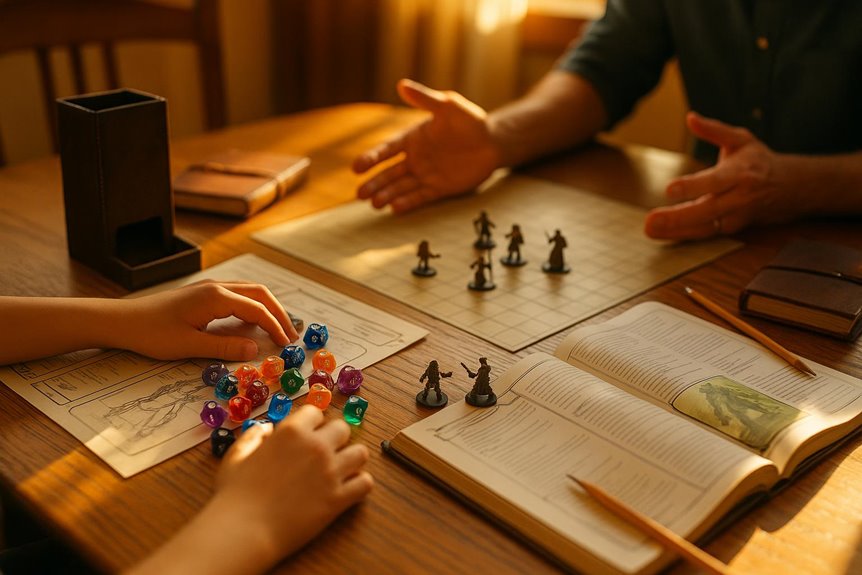
You’ve probably made thousands of decisions while playing RPGs, but have you noticed how those choices mirror the critical thinking you need in real life? When you’re weighing whether to trust an NPC’s information or determining if your party should split up to cover more ground, you’re exercising the same analytical muscles required for evaluating sources, assessing risks, and solving complex problems. The connection between game mechanics and practical reasoning runs deeper than you might expect.
How Game Mechanics Build Critical Thinking in RPGs
Role-playing games transform abstract thinking into tangible action through their mechanical frameworks. When you engage with RPG systems, you’re practicing game-based learning that develops critical thinking skills through every dice roll and character choice.
You’ll assess probabilities, weigh risks, and make informed decisions based on potential outcomes—skills directly transferable to real-world scenarios. The mechanics force you to analyze complex situations strategically.
You’ll interpret rules, negotiate with fellow players, and adapt your approach based on evolving circumstances. Logic puzzles and narrative challenges require you to synthesize information quickly and articulate solutions effectively.
Through character development, you’ll practice perspective-taking and ethical reasoning. Each decision making moment asks you to consider motivations, consequences, and group dynamics, sharpening your analytical abilities in collaborative environments.
Five Critical Thinking Skills RPGs Develop Through Play
Beyond understanding how RPG mechanics function, it’s valuable to examine the specific cognitive abilities these systems strengthen. When you play a tabletop RPG, you develop five essential critical thinking skills simultaneously.
First, you’ll enhance analytical reasoning by evaluating situations through your character’s attributes and capabilities.
Second, problem-solving improves as you navigate obstacles and adapt strategies.
Third, communication skills sharpen when you articulate intentions and negotiate with teammates.
Fourth, creative thinking flourishes as you craft backstories and devise innovative solutions to dilemmas.
Finally, perspective-taking develops when you inhabit different roles, strengthening your ability to evaluate scenarios from multiple viewpoints.
These cognitive skills transfer directly to real-world contexts, making tabletop RPGs powerful tools for developing critical thinking abilities beyond entertainment.
Teaching Evidence Evaluation Through RPG Scenarios
When a dragon merchant offers you information about a dungeon’s treasure in exchange for gold, you’ll naturally question whether they’re trustworthy—and that skepticism mirrors the evidence evaluation you need in everyday life.
RPGs create scenarios where you’ll constantly assess conflicting information from non-player characters, analyze their motives, and make decisions based on incomplete data. You’ll weigh characters’ actions against their words, identify potential biases, and synthesize clues scattered throughout the game world.
This process strengthens your ability to evaluate source credibility and reliability. Through collaborative discussion with other players, you’ll compare interpretations, challenge assumptions, and build arguments supporting your conclusions.
These mechanics train you to navigate misinformation by practicing discernment in a low-stakes environment where mistakes become learning opportunities rather than consequences.
Bringing Critical Thinking RPGs Into Your Classroom
Although you might worry about the logistics of bringing RPGs into your classroom, the practical reality proves far simpler than you’d expect. The System Reference Document 5.1 offers free access to character creation rules and tabletop role-playing game mechanics, eliminating cost barriers.
Educators like Kade Wells have demonstrated remarkable results, with students showing double growth on MAP test scores through RPG frameworks.
Start small by integrating RPG elements into existing lessons. History classes become immersive learning experiences when students roleplay historical figures making strategic decisions.
Literature transforms when characters debate ethical dilemmas. These scenarios naturally develop critical thinking as students analyze situations, collaborate on solutions, and navigate complex narratives.
The low-stakes environment encourages experimentation while building analytical skills that translate directly to academic performance.
Critical Thinking Success Stories From RPG Educators
Educators across the country are transforming their classrooms with RPG mechanics and seeing measurable results. Kade Wells doubled his students’ MAP test scores by integrating Dungeons & Dragons into his ELA curriculum, proving Tabletop RPGs enhance critical thinking abilities.
Emilie Rayner’s elementary students demonstrated improved reading skills through D&D gameplay, developing analytical capabilities essential for comprehension.
Patrick La Mar combined D&D with The Oregon Trail, creating deeper historical engagement that boosted assessment scores significantly. As dungeon master and teacher, he showed how RPG mechanics strengthen context-based critical thinking.
The Kentucky Educators for Role-Playing Games initiative now provides extensive resources for implementing these techniques. Case studies consistently reveal that role-playing elements enhance problem-solving and collaboration skills, making them powerful tools for developing students’ analytical capabilities.
Applying RPG Critical Thinking Skills to Real-World Decisions
These classroom successes reveal something profound: the critical thinking skills students develop at the gaming table don’t stay there. When you’re navigating Dungeons and Dragons scenarios, you’re constantly evaluating information, analyzing complex narratives, and weighing potential outcomes before acting.
This same analytical framework transfers directly to your real-world decision-making. Role-playing games train you to consider multiple perspectives, assess risks, and make informed decisions under uncertainty—skills you’ll use in career planning, conflict resolution, and strategic thinking.
The collaborative problem-solving you practice during gameplay strengthens your communication abilities and team dynamics in professional settings. Research confirms that students who engage in these tabletop experiences demonstrate improved academic outcomes precisely because critical thinking becomes their default approach to challenges.
Frequently Asked Questions
What Are the 4 C’s of Critical Thinking?
You’ll find the 4 C’s of Critical Thinking are Critical Thinking, Communication, Collaboration, and Creativity. They’re essential skills that’ll enhance your problem-solving abilities, decision-making processes, and effectiveness in both gaming and real-world situations.
What Are the 3 C’s of Critical Thinking?
The 3 C’s of Critical Thinking you’ll apply are Clarity, Creativity, and Consistency. They’ll help you understand scenarios clearly, develop innovative solutions, and maintain logical reasoning throughout your decision-making process in role-playing games.
What Are the Core Mechanics of an RPG?
You’ll find core RPG mechanics include character creation systems, action resolution methods like dice rolling, narrative-driven frameworks for storytelling, collaborative gameplay between players and GM, and character progression through leveling up or skill development.
What Is the Best Game for Critical Thinking?
You’ll find Dungeons & Dragons is the best game for critical thinking. It’ll challenge you to analyze situations, strategize actions, solve complex problems, and make decisions based on character motivations and potential consequences throughout gameplay.
Conclusion
You’ve seen how RPG mechanics transform abstract reasoning into tangible skills you’ll use beyond the gaming table. Whether you’re a teacher integrating these experiences into your classroom or a player recognizing your own growth, you’re building critical thinking capabilities that matter. Start incorporating RPG-based decision-making into your learning environment today. You’ll develop sharper analytical skills, clearer communication, and more thoughtful problem-solving approaches that’ll serve you in every real-world challenge you face.