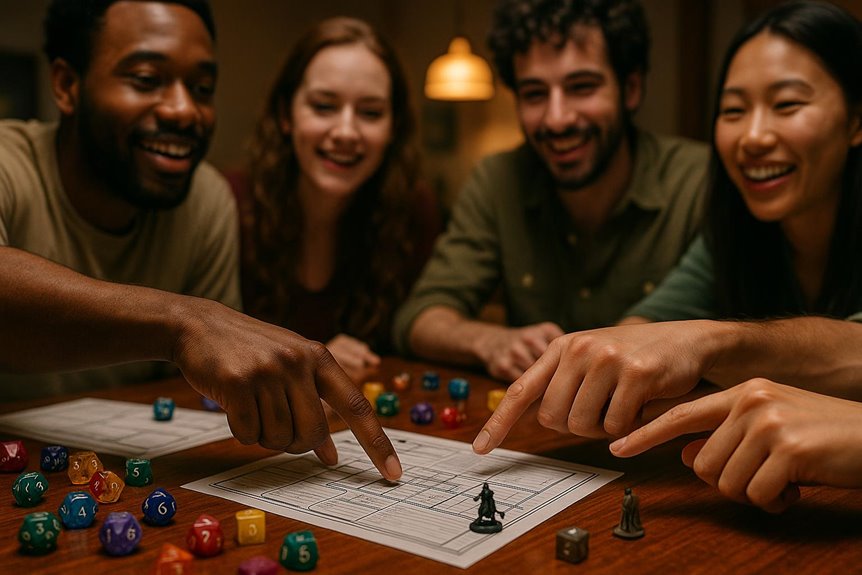
You’ve probably struggled through awkward small talk, misread social cues, or frozen during a tense conversation. What if you could practice these moments without real-world consequences? Role-Playing games or RPGs offer exactly that—a structured playground where you’ll navigate complex social situations through fictional characters. You’ll negotiate with merchants, persuade guards, comfort allies, and resolve conflicts, all while building skills that naturally carry over into your everyday interactions. Here’s how it works.
What Are Role-Playing Games?
RPG’s transform ordinary tabletops into portals for adventure, where players step into the shoes of characters navigating imaginary worlds guided by a Game Master.
You’ll find RPGs) like Dungeons and Dragons creating structured environments for collaborative storytelling, with over 40 million players worldwide engaging in these experiences.
Through RPG gameplay, you’re constantly developing social skills as you communicate with fellow players, make collective decisions, and work toward shared objectives. The mechanics require you to navigate complex group dynamics while tackling problem solving challenges together.
You’ll practice conflict resolution naturally as disagreements arise about strategy or character actions. This interactive format provides you with opportunities to experiment safely with different social approaches and communication styles.
How RPGs Create Safe Spaces for Social Learning
When you sit down at an RPG table, you’re entering a uniquely protected environment where social missteps carry minimal consequences. Your group provides safe spaces where experimentation with social interactions becomes rewarding rather than risky.
Through your character, you’ll practice communication skills without exposing your real-world vulnerabilities.
These games structure these interactions deliberately. You’ll negotiate with teammates, resolve conflicts through collaborative problem-solving, and explore different perspectives through character development. This framework lets you test empathy by inhabiting diverse motivations and backgrounds.
The supportive context matters tremendously. Your fellow players understand that mistakes enhance learning rather than warrant judgment.
You’ll practice teamwork, compromise, and emotional awareness while the game’s mechanics guide your social development. Regular sessions compound these benefits, strengthening your interpersonal abilities through consistent, enjoyable practice.
Core Social Skills You’ll Develop Through RPGs
Through regular gameplay, you’ll build communication skills as you articulate your character’s intentions, advocate for strategic decisions, and respond to others’ ideas. This constant practice strengthens your ability to express yourself clearly while receiving immediate feedback from fellow players.
You’ll master cooperation through collaborative storytelling, where teamwork becomes essential for navigating challenges and achieving shared victories.
Character-building exercises naturally develop empathy as you explore different perspectives, strengths, and flaws, fostering greater understanding of diverse viewpoints.
RPGs provide practical conflict resolution training when disagreements arise, teaching you to listen respectfully and negotiate effectively.
Additionally, you’ll cultivate patience by waiting for turns and managing frustrations from unpredictable dice rolls, building resilience that extends beyond the gaming table into everyday interactions.
Why RPGs Work Better Than Traditional Social Skills Training
While traditional social skills training often relies on scripted scenarios and artificial exercises, RPGs offer something fundamentally different: a living laboratory where you practice real social interaction under the guise of fantasy. Research by Simkins and Steinkuehler (2008) published in the journal Games and Culture, highlights how the complex ethical and social structures of RPGs act as a “sandboxed” reality, allowing players to grapple with high-level social problems that mirror real-world complexity.
You’ll receive real-time feedback on your choices, immediately understanding how your communication affects others. This creates stronger retention than passive learning methods. According to Rivers, Adams, and Lasser (2016), the immediate interpersonal feedback loop in tabletop games facilitates “situated learning,” where skills are acquired through active engagement rather than rote instruction.
The collaborative storytelling in RPGs naturally develops empathy as you navigate complex character motivations and perspectives. Daniau (2016) suggests that the “shared imaginative space” of an RPG forces players to undergo cognitive perspective-taking, a key component of empathy. Furthermore, a study by Abbott et al. (2022) found that the requirement to predict and respond to the emotional states of fellow players significantly improves social-emotional competencies over time.
You’ll experiment with new social behaviors in a low-stakes environment, reducing anxiety about making mistakes. Unlike conventional training that teaches rules, RPGs let you experience consequences organically. This aligns with the “Safe Space” theory popularized by Bowman (2010), who posits that “role-distancing”—the psychological gap between the player and the character—allows individuals to try on new social identities without the threat of real-world social stigma.
This immersive approach encourages risk-taking and spontaneous interaction, building authentic social skills through meaningful collaboration rather than memorization. As noted in research by Tychsen et al. (2006), the open-ended nature of these games rewards spontaneous problem-solving, which bridges the gap between theoretical knowledge and practical application, leading to more authentic social fluency than traditional, scripted behavioral interventions.
Building Confidence Through Character-Driven Play: Your Journey to Becoming a Dungeon Master
Character-driven play acts as a transformative catalyst, turning hesitant players into confident communicators by creating a “psychological buffer.” This safe distance between the player and their persona allows for a unique form of social experimentation; when you embody a character in an RPG, you are granted a license to practice self-expression without the fear of personal judgment. You can experiment with bold behaviors, authoritative tones, or vulnerable admissions that you might normally avoid in daily life.
Through consistent improvisation and meaningful decision-making, you develop a core sense of agency. As you witness your choices positively impact the narrative and the other players at the table, you begin to internalize a crucial realization: your voice matters, and your ideas have the power to shape a shared reality.
The Collaborative Foundation
The collaborative nature of character-driven play naturally strengthens your communication skills. As you negotiate strategies and assert your character’s perspective within a group dynamic, you are practicing the essential art of professional collaboration. You learn to advocate for yourself by articulating your character’s needs and preferences in low-stakes scenarios, providing a safe testing ground for new social approaches. This assurance is not contained within the game; it transfers directly to real-world interactions, from public speaking to interpersonal conflict resolution.
From Player to Architect: The Path to Dungeon Mastering
As you grow comfortable with this level of self-expression, you are already building the foundation required to step behind the screen as a Dungeon Master (DM). Transitioning to the role of DM is the ultimate exercise in character-driven confidence. While it may seem daunting, remember that you have already mastered the hardest part: the willingness to play and communicate.
- Leading with Empathy: Just as you embodied one character, as a DM, you will inhabit many. This broadens your emotional intelligence and adaptability, allowing you to guide the story while supporting your friends’ growth.
- Empowered Decision-Making: Taking on the mantle of DM allows you to practice “thinking on your feet” in a supportive environment. Every time you adjudicate a rule or describe a new landscape, you are refining your leadership style and authoritative presence.
- Creating the Safe Space: By becoming a DM, you transition from someone using the “buffer” to the architect who provides that safety for others. There is no greater boost to self-assurance than successfully facilitating a space where others feel brave enough to express themselves.
Each session you lead reinforces your ability to express yourself clearly and confidently. The skills you’ve honed as a player—active listening, creative problem-solving, and collaborative storytelling—are the exact tools needed to be a brilliant Dungeon Master. Embracing the DM chair is not just about running a game; it is the final step in proving to yourself that you can lead, inspire, and command a room with poise and creativity.
How RPG Social Skills Transfer to Real Life
The confidence you build at the gaming table doesn’t stay there—it follows you into job interviews, difficult conversations, and social gatherings. RPGs create a practice ground where you refine social skills without real-world consequences.
When you collaborate on storytelling with your gaming group, you’re developing teamwork abilities that transfer directly to workplace projects and community involvement. The conflict resolution techniques you use to navigate character disputes become tools for handling disagreements with coworkers and family members.
Perhaps most importantly, the empathy you cultivate through inhabiting different characters helps you understand diverse perspectives in real life. You’ll find yourself listening more actively, communicating more clearly, and approaching challenges with creative problem-solving strategies—all skills sharpened through consistent RPG participation.
Choosing the Right RPG for Social Skills Development
Finding the perfect Tabletop Role-Playing Game (TTRPG) is the first step toward meaningful social growth. Based on research in therapeutic recreation and educational psychology, here is how to select a game that aligns with your members’ development goals. Research (e.g., Henrich and Wright, 2020) supports the idea that different systems provide different “affordances.” While Dungeons & Dragons (D&D) is the industry standard for teamwork, its complex rules can often be a barrier to starting your own game with new players. Simpler systems (like Powered by the Apocalypse or Fate) reduce cognitive load, allowing players to focus more on social interaction.
Social skills do not have to be led by you alone either! There are many programs that can be accessed remotely or in person, depending on your location. PEERS (Program for the Education and Enrichment of Relational Skills) and Social Skills Training Autism—Frankfurt are two great examples of locations that use tabletop role-playing games for social skill expansion. These programs have increasingly integrated role-play elements to target specific social behaviors like eye contact, turn-taking, and conversational flow. A few other programs include:
- Skillstreaming: This widely implemented program employs a four-part instructional strategy—modeling, role-playing, performance feedback, and generalization—to teach prosocial behaviors to children and adolescents. It is often utilized in school settings across the country to address specific deficits in social-emotional learning.
• The UCLA PEERS® Clinic Expansion: Beyond the foundational curriculum, various certified providers nationwide offer specialized tracks of the PEERS program tailored specifically for preschoolers, adolescents, and young adults, focusing on making friends and managing peer conflict.
• Social Thinking® (Michelle Garcia Winner): A prominent nationwide framework that teaches the “why” behind social interactions. This program helps individuals understand the perspective of others and develop strategies for social problem-solving and flexible thinking.
• Model Me Kids®: This program utilizes video modeling as a primary tool, providing structured visual demonstrations of social skills in real-life contexts, such as playgrounds, classrooms, and community settings, helping individuals mirror appropriate social interactions.
• The Program for the Enrichment of Relational Skills (PERS): Similar to PEERS, this intervention focuses on didactic lessons and parent-assisted coaching to ensure that social skills are practiced and maintained in the home and community environments.
• Integrated Play Groups (IPG)®: Developed to support children on the autism spectrum in inclusive settings, this model brings together “expert players” (peers) and “novice players” (individuals with autism) to engage in mutually engaging play experiences facilitated by trained guides.
- Therapeutic Mechanics: The focus on empathy and perspective-taking is a hallmark of “Applied RPGs.” By inhabiting a character, players engage in “double empathy,” navigating both their own feelings and those of their fictional persona.
- Professional Oversight: The recommendation for licensed professionals is a standard best practice. While “TTRPGs for fun” are beneficial, “Therapeutic RPGs” (TRPGs) require a trained facilitator (like a therapist or specialized educator) to manage “bleed” —when in-game emotions spill over into real life—and to ensure clinical goals are met.
- (If you’d like to learn more about how to become a therapeutic dungeon master, you can explore specialized certification and training programs offered by organizations like Geek Therapy or Game to Grow, which provide comprehensive courses on utilizing tabletop role-playing games for social, emotional, and psychological development)
How This Helps in Finding the Right RPG
This text serves as a roadmap for selecting a game based on three critical factors:
- Complexity vs. Connection: If your goal is basic social entry for beginners, the text suggests avoiding heavy math/rule systems in favor of narrative-driven ones. This ensures the “game” doesn’t get in the way of the “socializing.”
- Specific Behavioral Targets: By referencing programs like PEERS, the text encourages you to look for games that mirror the specific skills you need. For example, if the goal is conflict resolution, you should choose a game that rewards non-violent solutions rather than just combat.
- Role Immersion: For those needing help with empathy, the text points toward games that prioritize “character motivations.” This helps you filter out “dungeon crawlers” (which focus on loot and stats) in favor of “drama-heavy” games (which focus on relationships).
Starting Your First Social Skills RPG Session
To transition from selecting a game to running your first session, consider these actionable steps:
- To adequately prepare for a social skills role-playing game (SS-RPG) session, you can build upon your existing framework by adding these essential preparatory steps. These additions focus on expert consultation, environmental setup, and logistical clarity to ensure the intervention is both therapeutic and engaging.
- Consult Evidence-Based Frameworks: Before finalized planning, consult major clinical and pedagogical sources such as the PEERS® curriculum or Game to Grow’s Method. These resources provide specific guidance on “social scaffolding” and “directed play.” Integrating these established methodologies ensures your session isn’t just a game, but a structured intervention backed by psychological research on social learning and neurodiversity.
- Establish a “Check-In” Ritual: Beyond Session Zero, define a specific opening ritual for every meeting. This might be a “high/low” share or a brief mindfulness exercise. Establishing this routine before the first dice roll helps lower anxiety by providing a predictable transition from the outside world into the “magic circle” of the game environment.
- Determine Data Collection Methods: If the goal is skill development, decide beforehand how you will track progress. Create a simple rubric or checklist based on the individual goals established in Session Zero. Knowing how you will measure a “successful negotiation” or “active listening” allows the facilitator to provide more accurate and encouraging feedback during the reflection period.
- Prepare Sensory and Physical Accommodations: Recognize that social skills training often involves sensory processing. Before players arrive, ensure the environment is comfortable. This includes providing fidget tools, ensuring lighting isn’t overstimulating, and having clear visual aids (like turn-order trackers or “NPC emotion cards”) available on the table to reduce the cognitive load of social interpretation.
- Draft a “Safety Toolkit”: While “Lines and Veils” are discussed in Session Zero, you must also implement active safety tools for use during play, such as The X-Card or Pause/Rewind/Fast-Forward mechanics. Preparing these physical or digital cards beforehand gives players a non-verbal way to signal discomfort, which is a vital component of creating the “safe opportunities” essential for vulnerable social practice.
Starting Your First Social Skills RPG Session
Starting your first social skills RPG session doesn’t have to be overwhelming—it’s really just about having fun while trying out new things. Rather than worrying about complex rules, you can simply focus on what feels natural, like exploring how to connect with others or navigate a tricky conversation. With just a little bit of prep, you’ll find it’s a supportive space where you can relax and grow at your own pace.
This barrier to entry is lower than ever thanks to a major shift in game design over the last decade. While older tabletop games were often defined by dense rulebooks and mathematical calculations, modern “rules-lite” systems have prioritized narrative flow and accessibility. Today, many popular games can be learned in under ten minutes, using just a handful of dice or a simple deck of cards to drive the story forward. This streamlined approach removes the mechanical friction that used to intimidate newcomers, allowing players to spend less time looking up definitions in a manual and more time engaging in the meaningful social interactions that make these sessions so transformative.
When selecting a tabletop role-playing game for your group, prioritizing accessibility can significantly lower the barrier to entry and keep the focus on the narrative in order to best support a social skills RPG session. Powered by the Apocalypse (PbtA) systems, for instance, utilize a “moves” based structure that triggers naturally from the fiction, ensuring that the story dictates the dice rolls rather than the other way around. For families or younger players, Hero Kids offers a streamlined introduction to fantasy adventuring, using simple d6 mechanics that children can grasp instantly. Meanwhile, Daggerheart provides a modern approach that balances tactical depth with a focus on character hope and fear, making it ideal for those who want emotional stakes without getting bogged down in math.
In addition to these specific titles, it is helpful to look for games that emphasize certain “rules-light” campaign structures:
- Fiction-First Gaming: Look for systems where the primary rule is “to do it, you have to do it.” If a player describes a daring leap, the mechanics support that action rather than requiring the player to memorize a specific list of technical combat maneuvers.
- Collaborative World-Building: Many accessible RPGs include mechanics for players to help build the setting. This ensures everyone is invested in the story from the very first session.
- Fail Forward Mechanics: Choose systems where a “bad” dice roll doesn’t simply mean “nothing happens.” Instead, these rules ensure that even a failure moves the plot forward in an interesting, if complicated, direction.
To maximize the chances of finding a game that perfectly fits your group’s specific personality and interests, I highly encourage you to browse platforms like DriveThruRPG. This massive digital marketplace allows you to filter games by “Rules Lite” or “Narrative” categories. You can often find “Quickstart” guides or “Pay What You Want” PDFs that allow you to test-drive a system before committing to a full campaign. By exploring the vast indie scene available online, you are much more likely to discover a hidden gem that you and your friends will enjoy for years to come.
To foster an effective learning environment, begin by establishing a judgment-free atmosphere where participants recognize that mistakes are not failures, but rather the essential fuel for growth. This psychological safety is most easily achieved in small group formats, which naturally lower the barrier to entry for quieter members. In these intimate settings, collaboration replaces competition, ensuring that every individual has the space to contribute meaningfully to the collective experience.
Structure your session with a sequence of deliberate, goal-oriented activities that go beyond simple play. By pausing at critical junctures, you can encourage participants to reflect deeply on their in-game choices and the consequences that followed. These moments of pause allow players to identify real-world parallels, recognizing how their digital or tabletop decisions mirror the ethical and professional dilemmas they face in daily life.
Throughout the gameplay, serve as an active facilitator by bridge-building between fictional scenarios and actual social dynamics. For instance, when players navigate complex character conflicts or engage in high-stakes negotiations with NPCs, take the opportunity to examine the specific communication strategies they employed—such as active listening, persuasion, or de-escalation. Analyzing these interactions in real-time helps participants see the mechanics behind social success and friction.
Ultimately, these structured activities serve to transform passive entertainment into a series of practical, hands-on skill-building experiences. By explicitly connecting game mechanics to interpersonal theory, you provide participants with a versatile toolkit of social and cognitive strategies. This ensures that the insights gained during the session are not confined to the gaming table but are successfully translated into their personal and professional lives.
Frequently Asked Questions
Can People With Social Anxiety Truly Benefit From RPGS?
Absolutely. Committing to a regular tabletop RPG session with friends is far more than just a hobby; it is a multi-layered tool for personal development and mental well-being. These games provide a unique form of structured social interaction within a controlled, low-stakes environment, which can be particularly transformative for those who find traditional social settings overwhelming.
By participating in a campaign, you have a safe laboratory to practice complex communication skills—such as negotiation, active listening, and conflict resolution—all through the lens of a fictional persona. This “character shield” is vital; it allows you to focus the social spotlight on your character’s motivations rather than your own insecurities, significantly reducing the immediate pressure of performance anxiety.
As the narrative progresses, players often find themselves building confidence gradually. Navigating a difficult dungeon or solving a collaborative puzzle provides a sense of collective achievement that translates into real-world self-assurance. Furthermore, the shared storytelling aspect fosters deep, authentic relationships. Because the game requires consistent cooperation and empathy to succeed, it bypasses the “small talk” phase of friendship and moves directly into meaningful connection, creating a supportive community that extends far beyond the gaming table.
How Long Before Players Notice Real-World Social Improvements?
You’ll typically notice improvements within 3-6 months of consistent play. However, some players report feeling more confident in conversations after just a few sessions, especially when they’re actively practicing new communication skills during gameplay.
Are Online RPGS as Effective as In-Person Sessions?
Online RPGs can be effective, but you’ll typically develop stronger social skills in-person. You’re missing crucial nonverbal cues and body language online, though they still help with communication, collaboration, and confidence-building skills.
What if Players Revert to Old Habits Outside Games?
You’ll need to practice transferring skills intentionally. Set reminders to use active listening or assertiveness techniques daily. Consider bridging sessions where you’ll discuss real-world applications. Gradual improvement’s normal—celebrate small wins outside gaming contexts.
Can RPGS Help Children With Autism Spectrum Disorder?
You’ll find RPGs can help children with autism by providing structured social interaction, clear rules, and predictable scenarios. They’ll practice communication, emotional recognition, and turn-taking in a safe, controlled environment that reduces anxiety.
Conclusion
You’ve seen how RPGs transform social learning through character-driven experiences that feel more like play than practice. By stepping into different roles, you’ll build genuine confidence in communication, empathy, and collaboration—skills that’ll naturally flow into your everyday interactions. Don’t wait for the “perfect” moment to start. Gather some friends, choose a game that resonates with you, and begin your journey. Your next gaming session isn’t just entertainment—it’s an investment in becoming a more socially capable, confident version of yourself.