Category: Micro-Adventures

  • Homeschool Curriculum Meets Campaign World: How to Build Family Memories While Hitting Learning Objectives

    Homeschool Curriculum Meets Campaign World: How to Build Family Memories While Hitting Learning Objectives

    Tuesday afternoon. Your twelve-year-old sits at the kitchen table, pencil moving mechanically across a multiplication worksheet. She gets the answers right. You check the box on your lesson plan. But when you ask her three days later to apply those same concepts to a word problem, she stares blankly at the page.

    Sound familiar?

    You're caught between two equally uncomfortable truths. The first: learning objectives matter. Your child needs to master fractions, understand photosynthesis, and write coherent paragraphs. The second: worksheets completed in isolation tend to evaporate from memory within days, leaving behind no trace except a filing cabinet full of completed assignments.

    Most homeschooling parents accept this as an unavoidable trade-off. Fun activities create memories but feel academically lightweight. Rigorous curriculum hits objectives but produces little long-term retention or family connection.

    What if that's a false choice?

    The Science Behind Stories and Memory

    Cognitive psychology research consistently demonstrates that information embedded in narrative context shows significantly higher retention rates than isolated facts. When your child encounters a math problem while calculating how many healing potions the party can afford before entering a dragon's lair, something different happens in their brain.

    The context provides what researchers call "retrieval cues": mental hooks that make information easier to access later. Evidence suggests that memories formed within rich, multi-sensory contexts are more resistant to forgetting than those acquired through rote repetition.
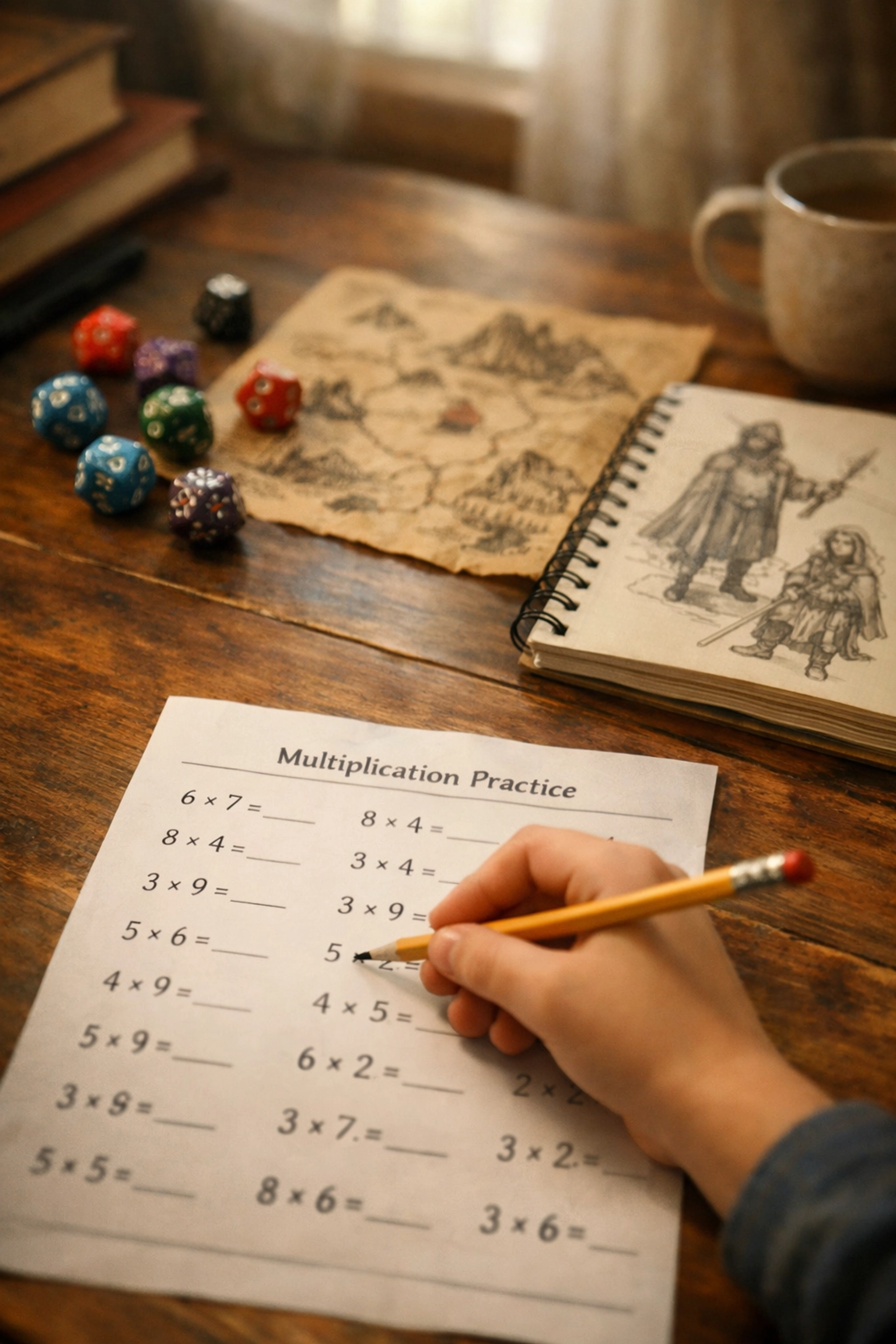
    Homeschool math worksheet with dice and fantasy game materials on kitchen table

    This isn't educational theory. It's how human memory evolved to function. Our ancestors didn't learn survival skills through flashcards. They learned by embedding knowledge within the story of their lived experience: which plants caused illness, which trails led to water, which warnings meant danger.

    Tabletop roleplaying games recreate this natural learning environment within your homeschool day. The learning objectives remain unchanged. The difference is that your child now encounters them within a narrative that provides meaning, context, and emotional resonance.

    What Retrieval Practice Actually Looks Like at the Table

    Here's where most educational approaches stumble. They assume retrieval practice means quizzes, flashcards, or verbal questioning. Those methods work, but they're not the only path.

    When your child's character needs to calculate the trajectory of a catapult to breach a castle wall, they're practicing physics. When they must persuade the city council using historically accurate arguments from the Renaissance period you just studied, they're retrieving historical knowledge. When they write a letter to an NPC in character, they're applying grammar and composition skills.

    The critical element isn't the game mechanics. It's the retrieval opportunity happening naturally within a context that matters to your child.

    Most studies on retrieval practice focus on testing as the intervention. But retrieval simply means pulling information from memory rather than reviewing notes. Any scenario requiring your child to access previously learned information without prompts qualifies. The campaign world becomes a landscape of continuous, low-stakes retrieval opportunities.

    Building the Bridge Between Objectives and Adventures

    You don't need to abandon your current curriculum. You're adding a layer that transforms how your children interact with the material.

    Start with your existing learning objectives for the week. Let's say your seventh-grader needs to understand photosynthesis, practice multiplying fractions, and study ancient Mesopotamian civilization.

    Within your campaign narrative, create scenarios that naturally require this knowledge. The party encounters a mysterious plague affecting crops: understanding photosynthesis becomes necessary to identify the problem. They must calculate supplies for a caravan journey using fractional portions. The adventure takes them to a city-state modeled on ancient Babylon, where cultural knowledge determines their success in diplomatic encounters.
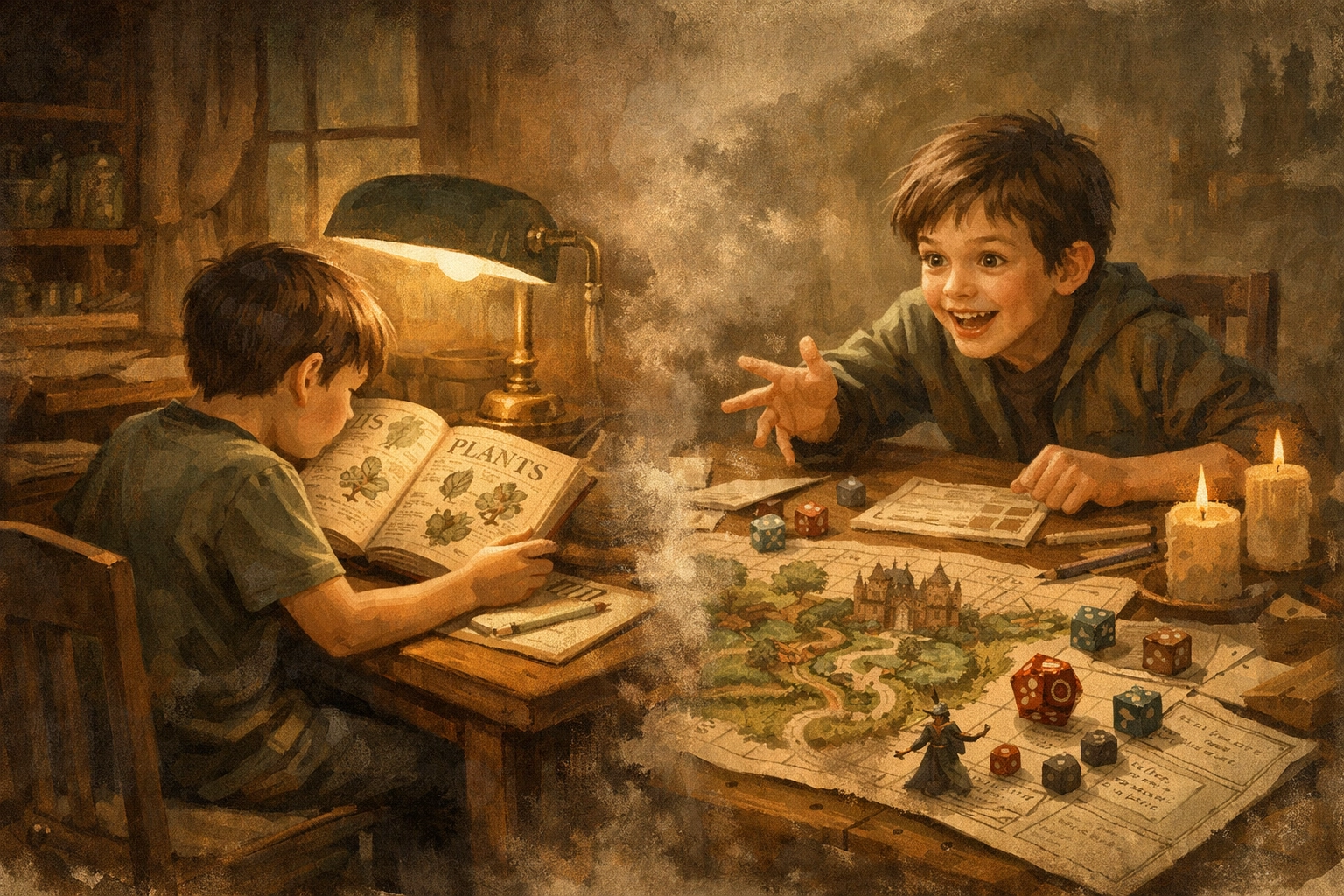
    Child studying textbook compared to engaged tabletop game learning experience

    This isn't camouflaging learning as fun. It's recognizing that the same information, when encountered within meaningful context, gets processed differently by the brain. Your child still needs to understand the light-dependent reactions of photosynthesis. But now they're applying that understanding to solve a problem that matters within the story they're creating together.

    The Tabletop Teaching Playbook framework provides structure for this integration. Each encounter becomes an opportunity to embed learning objectives within collaborative storytelling. The template helps you map curriculum requirements to narrative scenarios without forcing connections that feel artificial.

    The Memory-Building Gap in Traditional Homeschooling

    Here's what often gets lost in curriculum catalogs and standardized assessments: your child will remember almost nothing about their education except the moments that mattered.

    Ten years from now, they won't recall Tuesday's grammar worksheet. They might not even remember the novel they analyzed in eighth grade. But they will remember the night the entire family stayed up late solving the riddle that saved the kingdom. They'll remember their younger sibling's creative solution to an impossible problem. They'll remember your reaction when their character made a choice that surprised everyone at the table.

    This appears to work for many families because it addresses both memory systems simultaneously. Your child acquires the procedural knowledge they need for academic success while building episodic memories that anchor family identity and connection.

    Those family memories aren't separate from learning. They're the scaffold that makes learning stick.

    Practical Implementation Without Curriculum Overhaul

    You don't need to redesign your entire homeschool approach. You're adding one sustained narrative thread that runs alongside your existing structure.

    Reserve two hours weekly for your campaign session. Review upcoming learning objectives from all subjects. Identify three to five concepts that could naturally arise during the adventure. Build your encounter around scenarios that require those specific knowledge applications.
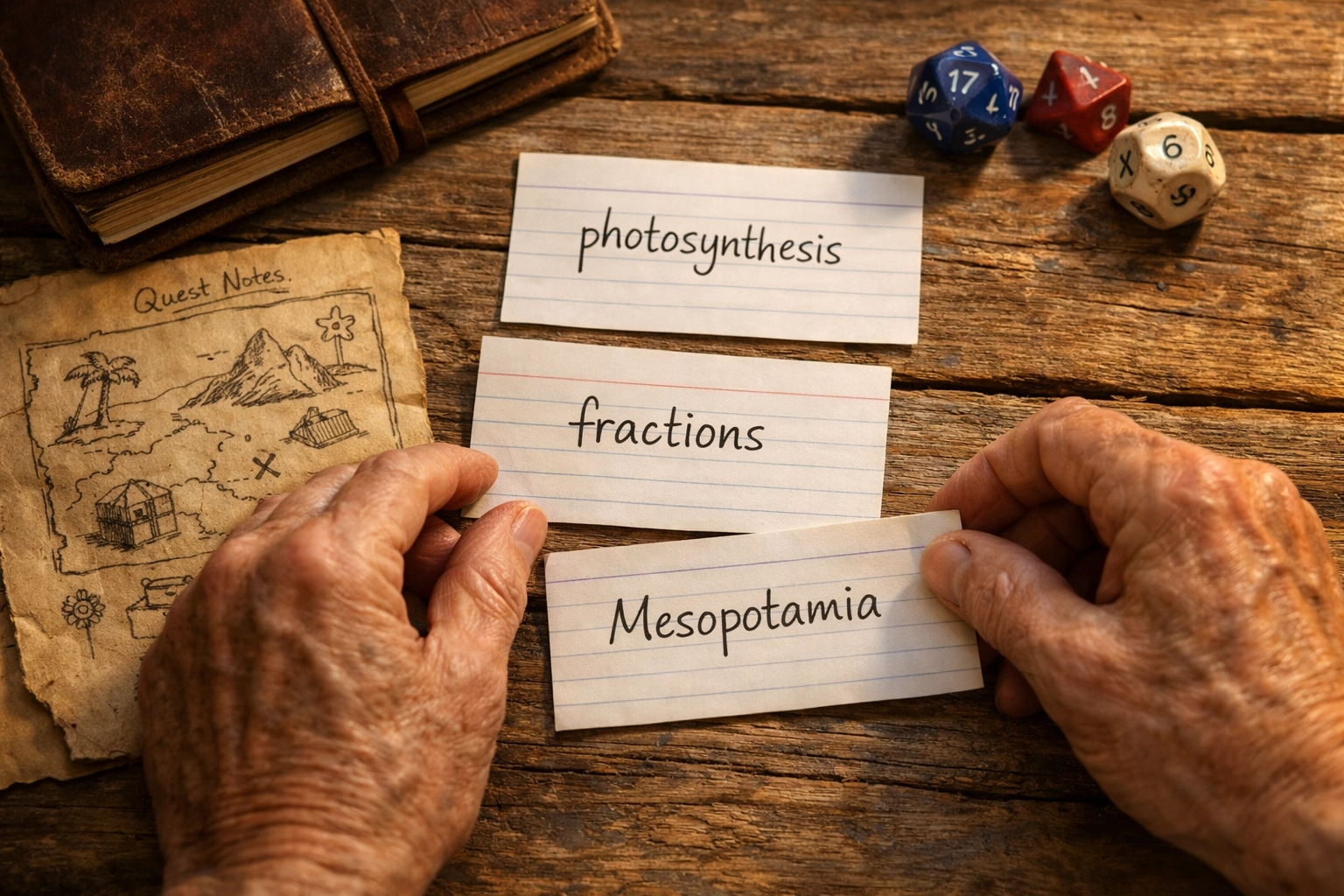
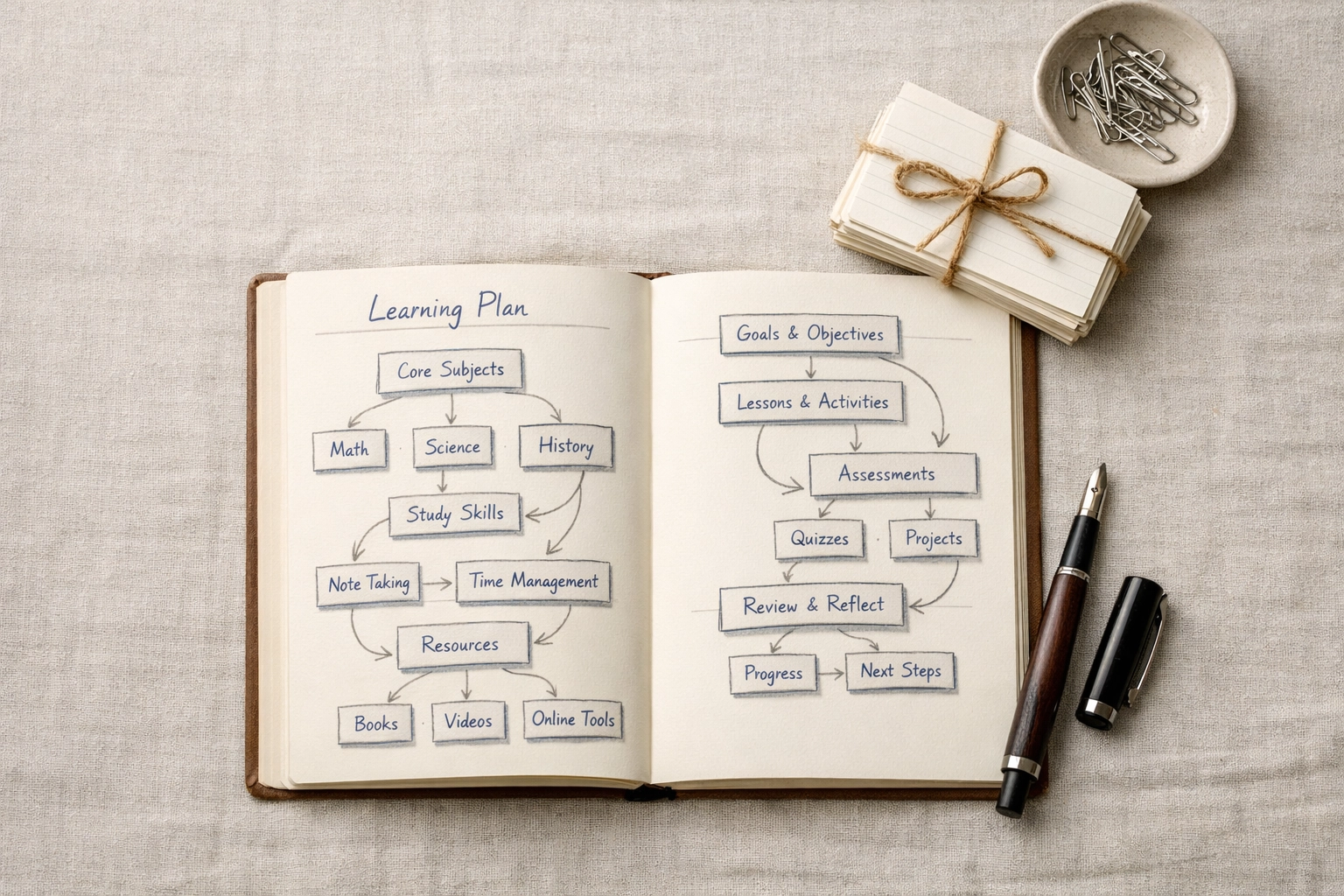
    Planning homeschool curriculum with learning objective cards and game notes

    Your ten-year-old studying the water cycle? The adventure enters a region experiencing drought. Understanding evaporation, condensation, and precipitation becomes necessary to help the village. Your teenager learning about constitutional government? They're helping draft a charter for a newly independent settlement.

    The preparation time feels substantial initially. Most educators report that planning becomes faster once you develop the pattern recognition skill of spotting natural connections between curriculum and narrative.

    The Encounter Template within the Tabletop Teaching Playbook provides a structured approach for this planning phase. It walks you through identifying learning objectives, designing retrieval opportunities, and creating narrative contexts that feel organic rather than forced.

    When Objectives and Adventures Align

    The turn here isn't subtle. It's the moment you realize that academic rigor and family connection aren't opposing forces requiring careful balance. They're complementary aspects of effective education.

    Your daughter who stared blankly at that word problem three days after completing the worksheet? Put the same mathematical concept into a scenario where her character needs to calculate damage resistance, and watch her retrieve the formula without hesitation. Not because games are inherently superior to worksheets, but because the context provides retrieval cues that isolated practice cannot.

    This doesn't mean every learning objective translates perfectly to tabletop scenarios. Some skills still require direct instruction and deliberate practice. The campaign world isn't a complete curriculum replacement. It's an additional tool that makes certain types of learning more durable and meaningful.

    The Evidence Suggests Something Worth Considering

    Research on context-dependent memory indicates that information learned in one environment shows improved recall when retrieved in similar contexts. While most studies examine physical locations, narrative contexts appear to function similarly: creating a mental landscape where learned information can be anchored and later accessed.

    The practical implication for your homeschool: learning that happens within your ongoing campaign world gets tagged with more retrieval cues than learning that happens in isolation. Those cues make the information more accessible when your child needs it later, whether that's on an assessment, in a real-world application, or during the next adventure.

    This framework doesn't guarantee perfect retention or eliminate the need for review. It provides an additional pathway for information to enter long-term memory while simultaneously creating the family experiences that make your homeschool years memorable.

    Join the Adventure

    The Tabletop Teaching Playbook provides the structure you need to integrate learning objectives with campaign narratives. The Encounter Template specifically addresses the planning challenge: helping you identify natural connections between curriculum and story without extensive game design experience.

    Whether you're new to tabletop gaming or you've been running campaigns for years, the template adapts to your family's learning needs and your comfort level with game mechanics. It's designed to support educational goals first, with the game serving as the delivery system rather than the primary focus.

    Ready to build family memories while hitting your learning objectives? Join our mailing list and get early access to the Encounter Template when it launches. You'll receive practical frameworks, encounter planning tools, and evidence-based strategies for integrating tabletop teaching into your homeschool routine.

    The campaign world is waiting. Your curriculum objectives are coming with you.


    Disclaimer: Adult or guardian supervision is required during all tabletop gaming sessions. The information provided in this article is for educational purposes only and is not intended as medical, therapeutic, or professional advice. Tabletop Teaching materials are designed to support learning objectives and family engagement. Individual results vary. Consult with qualified educational professionals regarding your specific homeschooling requirements and your child's individual learning needs.

    Publisher Non-Affiliation Notice: Tabletop Teaching is not affiliated with, endorsed by, or sponsored by Wizards of the Coast, Paizo Publishing, or any other tabletop roleplaying game publisher. Any references to Dungeons & Dragons, Pathfinder, or other TTRPG systems are used for descriptive and educational purposes only. All trademarks and copyrights belong to their respective owners.


  • The Tabletop Teaching Playbook: Better Learning with Less Daily Friction

    The Tabletop Teaching Playbook: Better Learning with Less Daily Friction

    You've seen it before. The worksheet is half-finished. Your kid, bright, curious, capable, sits at the table, staring at the same math problem they solved yesterday. And the day before. And last week.

    You ask them to explain their answer. They shrug. "I don't remember."

    It's not defiance. It's not laziness. It's the reality of how most traditional learning environments are structured: isolated practice, decontextualized problems, and assessment that feels disconnected from meaning. The knowledge doesn't stick because the learning never required them to use it in a way that mattered.

    This is the daily friction most families experience. The homework battles. The tutoring sessions that feel like pulling teeth. The growing sense that more exposure, more repetition, more worksheets aren't actually solving the problem.

    What if the issue isn't the child, but the delivery system?

    The Experiential System: What Game-Based Learning Actually Means

    Let's start by clearing up a common misconception. When we say "game-based learning," we're not talking about gamification, the practice of bolting points, badges, and leaderboards onto traditional curricula to make kids more compliant.

    Gamification is behavioral scaffolding. It's extrinsic motivation dressed up in bright colors. And here's the test: if you remove the points and the learning stops, it was never really learning. It was operant conditioning.

    Game-based learning is something else entirely. It's a system of play where choices have consequences, where students must make decisions based on incomplete information, retrieve prior knowledge under pressure, and experience feedback loops that reinforce understanding through meaningful action.

    Research on retrieval practice and desirable difficulties suggests that learning is most durable when it requires effortful cognitive processing (Bjork & Bjork, 2011). Tabletop role-playing games naturally create these conditions. A child solving for the area of a room isn't completing a worksheet, they're deciding whether their character can fit through a doorway while water is rising. The math becomes necessary, not ornamental.

    Child pausing over incomplete worksheet showing educational friction in traditional learning

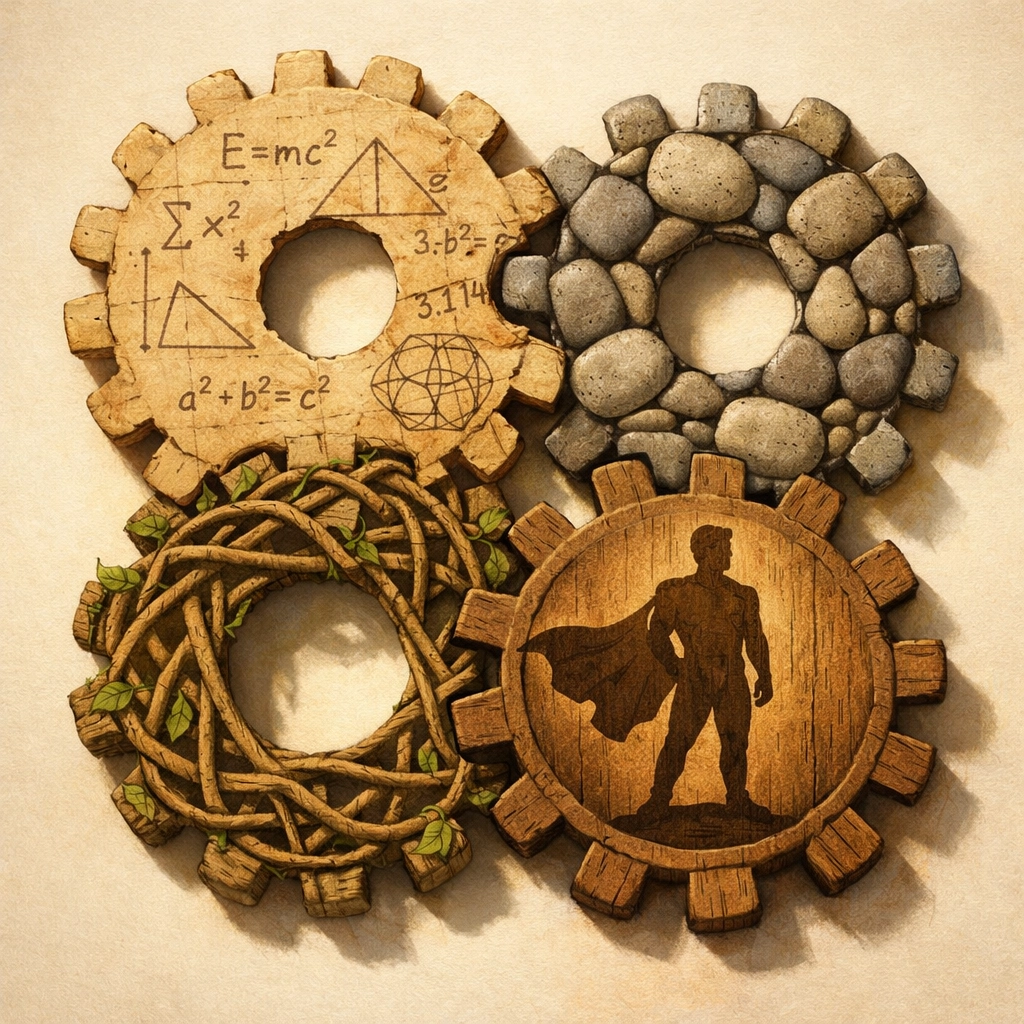
    The Table Atoms: Four Domains Every Encounter Can Train

    The Tabletop Teaching Playbook is designed to support learning across four interconnected domains we call the Table Atoms. Every scene, quest, or encounter you design can target one or more of these:

    1. Academic Literacy

    This is the content knowledge, math, reading comprehension, historical reasoning, scientific method. But unlike isolated skill drills, academic literacy in this system is always embedded in context. Students aren't solving for x because the worksheet says so. They're solving for x because the bridge won't hold without the correct calculation.

    2. Social-Emotional Learning (SEL)

    Collaborative problem-solving, perspective-taking, emotional regulation under uncertainty, these aren't separate "soft skills." They're cognitive demands that arise naturally when students work together to navigate complex scenarios. Research on cooperative learning indicates that structured group problem-solving can improve both academic outcomes and social competence (Johnson & Johnson, 2009).

    3. Projective Identity

    This is the role the child inhabits at the table. Not "student," but investigator, builder, healer, strategist. Projective identity allows learners to take intellectual risks they might avoid in traditional settings because failure isn't personal, it's part of the character's journey. This concept, drawn from game studies scholar James Paul Gee, aims to create psychological safety for exploration (Gee, 2003).

    4. Systems Thinking

    The ability to see relationships, feedback loops, and unintended consequences. In a tabletop scenario, pulling one lever affects three other mechanisms. Helping one NPC might alienate another. Students begin to think ecologically, to see learning as interconnected rather than siloed.

    Each Table Atom serves a purpose, and the beauty of the system is that you don't need to target all four in every encounter. Pick one or two per scene. Over the course of a campaign, students will cycle through all of them naturally.

    Four interconnected gears representing Table Atoms domains in game-based learning

    The GM Role: Building Knowledge with 'Yes, And' and 'Yes, But'

    Here's where the system diverges sharply from traditional teaching. The adult at the table isn't "the boss." They're the Game Master (GM), a role borrowed from tabletop gaming but adapted for learning contexts.

    The GM facilitates, complicates, and rewards. Three core tools make this work:

    "Yes, And" builds momentum. When a student proposes a creative solution, the GM doesn't shut it down, they extend it. "Yes, you can use the rope to cross the chasm, and you'll need to calculate how much weight it can hold."

    "Yes, But" adds constraint without negation. "Yes, you can attempt that spell, but it will cost you half your remaining energy, and you'll need to explain the chemical reaction that powers it."

    The Rule of Cool rewards ingenuity. If a student proposes something clever, narratively interesting, and educationally sound, the GM allows it, even if it wasn't in the original plan. This isn't permissiveness. It's recognizing that learning happens when students see their reasoning valued.

    This approach is rooted in constructivist learning theory, which suggests that knowledge is built through active engagement and social negotiation, not passive reception (Vygotsky, 1978). The GM creates the conditions for that construction.

    Mapping: Campaigns, Arcs, and Quests

    One of the most common questions we hear: How do I plan this without it taking over my life?

    The answer is structural clarity. The Tabletop Teaching Playbook maps directly onto traditional curriculum planning:

    • Campaign = Unit of Study. A semester-long exploration of fractions, or the Revolutionary War, or ecosystems.
    • Arc = Chapter. A multi-session storyline that explores one major concept or skill cluster within the campaign.
    • Quest = Assessment. A discrete challenge that allows students to demonstrate understanding. Not a test. A scenario with stakes.

    For example, a fractions campaign might include an arc about comparing quantities, with individual quests like "divide the treasure fairly among the adventuring party" or "measure ingredients for a potion that requires precise ratios."

    This isn't busywork dressed up in fantasy language. It's retrieval practice, spaced repetition, and transfer of learning, all research-backed strategies for long-term retention (Roediger & Butler, 2011), embedded in a structure that feels coherent to both the adult and the child.

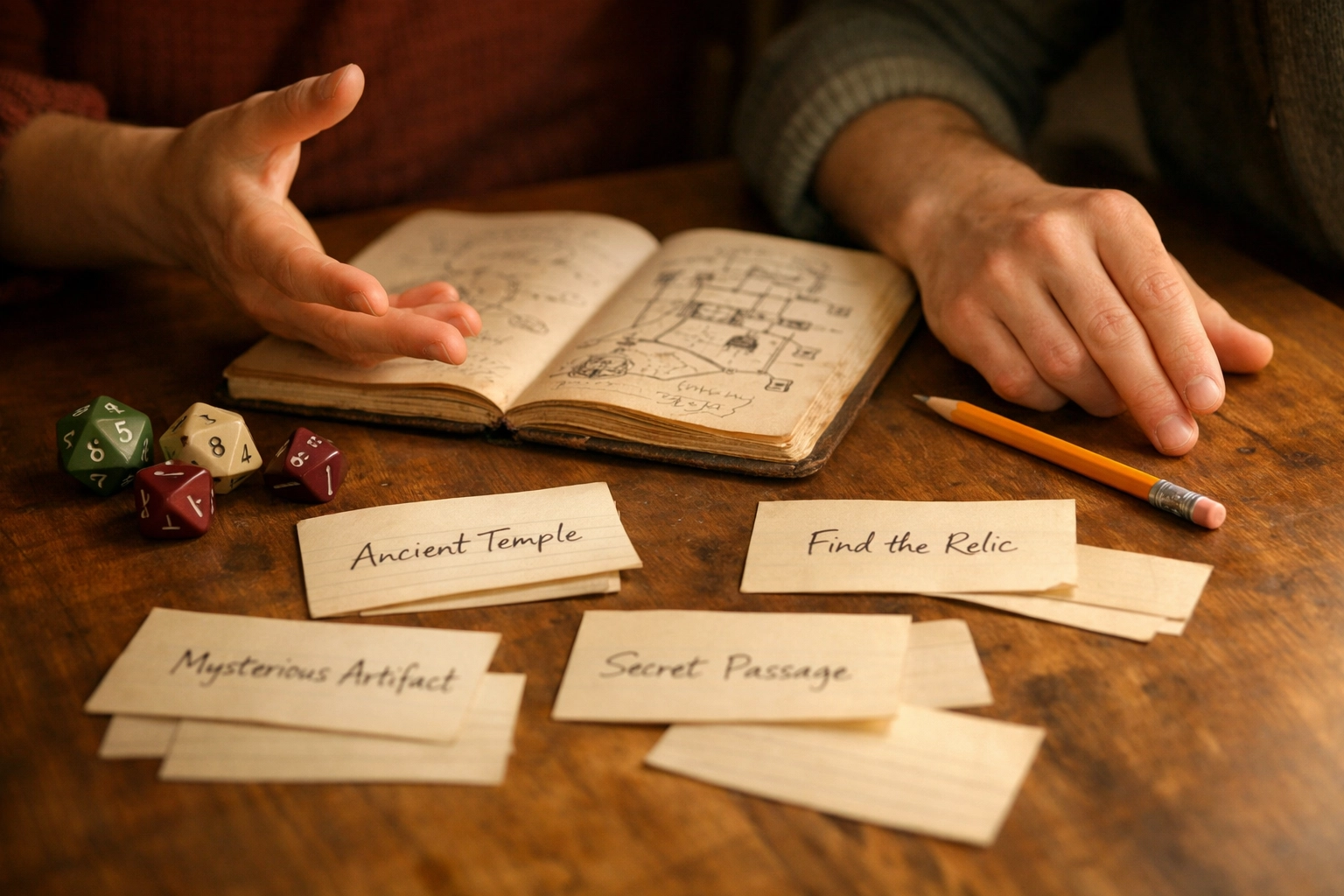
    Hands collaborating over notes and dice during tabletop teaching session

    Safety First: The Foundation for Risk-Taking

    None of this works if the table doesn't feel safe.

    We're not talking about physical safety, though that matters too. We're talking about psychological safety, the conditions that allow a learner to make mistakes, ask questions, and propose ideas without fear of judgment or ridicule.

    Every table needs co-created norms. Before the first session, the group agrees on how they'll treat each other, what topics are off-limits, and how they'll handle moments of discomfort.

    We recommend simple, portable safety tools borrowed from the broader tabletop gaming community:

    • The X-Card: Anyone can tap out of a scene, no questions asked, if it's making them uncomfortable.
    • Lines and Veils: "Lines" are hard boundaries (topics we won't include). "Veils" are things that can happen off-screen (we acknowledge them, but don't narrate them in detail).
    • Pause/Rewind: If something goes wrong, anyone can pause the game, discuss what happened, and rewind to try again.

    These aren't coddling. They're the same risk-management strategies used in improv theater, therapeutic role-play, and high-stakes team simulations. Research on learning environments indicates that students take more intellectual risks, and therefore learn more deeply, when they trust the social structure around them (Dweck, 2006).

    The Turn: This Isn't About Making Learning Fun

    Here's the realization that often surprises people: the goal of the Tabletop Teaching Playbook isn't to make learning fun.

    Fun is fine. Fun is welcome. But fun is a byproduct, not the mechanism.

    The mechanism is cognitive necessity. When a student must retrieve knowledge, apply it under constraint, and experience the consequences of their reasoning in real time, learning happens whether or not they're smiling.

    Sometimes the table is fun. Sometimes it's tense, challenging, frustrating in the way that good problems are frustrating. Sometimes students argue about strategy, negotiate solutions, or sit in silence while they think.

    That's not a bug. That's the system working.

    Traditional education often conflates engagement with entertainment. The Tabletop Teaching Playbook aims to create engagement through meaningful challenge, problems worth solving, choices that matter, and feedback that's immediate and informative.

    Learning planner with curriculum mapping flowcharts for tabletop teaching campaigns

    What This Looks Like in Practice

    Let's bring this down to earth. You're working on multiplication with a third-grader who has memorized the times tables but can't apply them flexibly.

    In a traditional setting, you'd assign more worksheets. More timed drills. More repetition.

    In the Tabletop Teaching Playbook, you might create a quest: "The village blacksmith needs 6 swords, each requiring 8 iron ingots. How many ingots total? You have 50 in the storehouse. Is that enough? If not, how many more do you need to mine?"

    The child isn't doing multiplication because you told them to. They're doing it because the village needs weapons and the math determines whether the quest succeeds.

    Then you complicate it. "Yes, you can mine more iron, but it will take three days, and the enemy army arrives in five. What's your backup plan?"

    Now they're thinking about time constraints, resource allocation, and alternative strategies: all while practicing the core skill.

    This is the experiential system in action. Academic literacy (multiplication), systems thinking (resource management), and projective identity (the heroic role of village protector) woven together in a single encounter.

    Moving Forward: The Five Supporting Posts

    This cornerstone post introduces the framework. Over the coming weeks, we'll break down each component in detail:

    • Game-Based Learning vs. Gamification (a deeper dive into what makes choices meaningful)
    • The Table Atoms (how to design encounters that target specific domains)
    • The GM Role (scripts, language, and facilitation techniques)
    • Safety First (printable tools and session-zero templates)
    • The Encounter Template (a ready-to-use structure for building your own quests)

    Each post will give you practical, immediately usable tools. Because the goal isn't to add more to your plate. It's to give you a system that reduces the daily friction: for you and for the learners you're supporting.

    The Tabletop Teaching Playbook is designed to support durable learning, not compliance. It's built on research-backed principles of retrieval, spacing, interleaving, and transfer. And it's structured to fit into the time and energy you actually have, not the idealized version of homeschooling or tutoring that exists only in someone's Instagram feed.

    You don't need to be an expert. You don't need a teaching degree or a background in game design. You just need to be willing to sit across the table, ask "what do you do?", and let the learning unfold from there.


    Adult/Guardian supervision is required. Use age-appropriate content and follow family/school policies. We recommend safety tools like Pause/X-Card. Educational guidance only; not medical advice.


    References

    Bjork, R. A., & Bjork, E. L. (2011). Making things hard on yourself, but in a good way: Creating desirable difficulties to enhance learning. Psychology and the Real World: Essays Illustrating Fundamental Contributions to Society, 2, 59-68.

    Dweck, C. S. (2006). Mindset: The new psychology of success. Random House.

    Gee, J. P. (2003). What video games have to teach us about learning and literacy. Palgrave Macmillan.

    Johnson, D. W., & Johnson, R. T. (2009). An educational psychology success story: Social interdependence theory and cooperative learning. Educational Researcher, 38(5), 365-379.

    Roediger, H. L., & Butler, A. C. (2011). The critical role of retrieval practice in long-term retention. Trends in Cognitive Sciences, 15(1), 20-27.

    Vygotsky, L. S. (1978). Mind in society: The development of higher psychological processes. Harvard University Press.