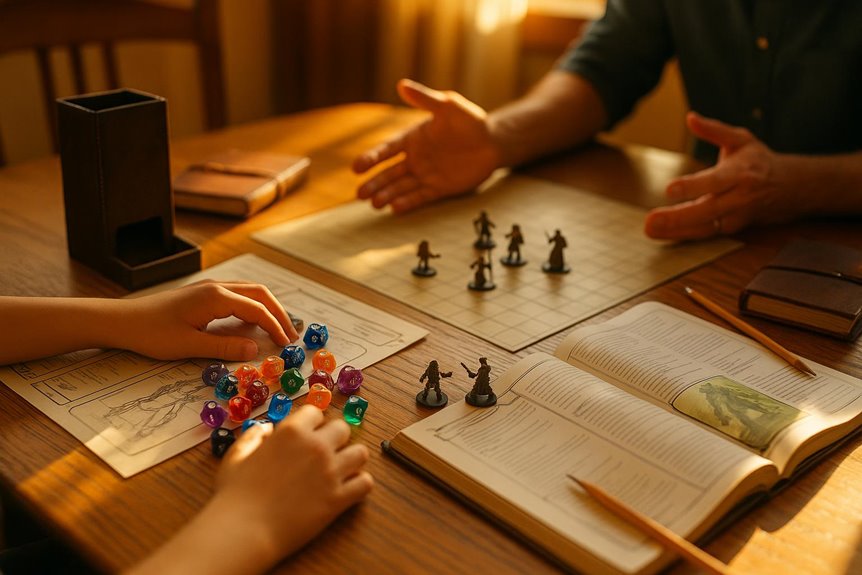
You’ve probably noticed how quickly your kids disengage when lessons feel like, well, lessons. Tabletop RPGs flip that script entirely—suddenly math problems become treasure calculations, history transforms into lived adventures, and writing turns into character backstories your students actually want to create. But not all RPGs suit homeschool environments equally. Some demand too much prep time, while others lack the educational depth you’re after. The right choice depends on your students’ ages and learning goals.
Why Tabletop RPGs Work So Well for Homeschooling
While traditional textbooks often struggle to maintain student engagement, tabletop RPGs transform learning into an adventure that homeschool families can’t wait to experience.
You’ll find that these games naturally build collaboration and teamwork as your children work together on group storytelling and shared decision-making. The narrative-driven format encourages creative thinking while tackling complex problems in hands-on scenarios.
Tabletop RPGs strengthen literacy through constant reading, writing, and communication during gameplay. You can personalize the pacing and content to match your children’s unique learning styles.
Many educational RPGs seamlessly integrate real-world subjects like history and environmental science, making lessons interactive and relevant to your students’ interests. This flexible structure lets you create engaging educational experiences that feel less like schoolwork and more like entertainment.
What Makes a Great Homeschool TTRPG
The best homeschool TTRPGs share five essential qualities that transform them from simple games into powerful educational tools.
First, you’ll want simplified mechanics that let everyone participate regardless of experience. A streamlined game system prevents overwhelming newer players while maintaining engagement.
Second, look for educational themes woven into narratives—history, science, and problem-solving opportunities that reinforce learning objectives naturally.
Third, prioritize collaborative storytelling that builds communication and teamwork skills through social interaction.
Fourth, seek games with structured setups and ready-made adventures. These save you precious lesson planning time while ensuring smooth gameplay.
Finally, choose RPGs incorporating social-emotional learning elements. These promote empathy and understanding, strengthening peer relationships while supporting personal growth throughout your homeschooling journey.
Best Homeschool TTRPGs for Elementary Students (Ages 4-10)
Academy of Heroes targets first-timers with simple rules and recognizable hero archetypes.
For outgoing kids, TOON delivers high-energy gameplay where they’ll role-play cartoon characters in imaginative, non-serious adventures that keep engagement high.
Hero Kids: The Perfect First TTRPG for Young Learners
The game naturally develops creativity, teamwork, and storytelling abilities, making it an excellent social-emotional learning tool. Your homeschoolers will build cooperative skills through shared problem-solving and character-driven narratives.
Hero Kids offers diverse supplements and settings that align with different interests, ensuring your lessons stay fresh and captivating.
You can purchase this tabletop RPG online easily, making it accessible for any homeschooling family. It transforms learning into adventure while teaching valuable life skills through imaginative play.
Amazing Tales: Scalable Mechanics That Grow With Your Child
While Hero Kids excels at introducing younger children to tabletop gaming, Amazing Tales offers something uniquely valuable: a system that adapts to your child’s developmental stage.
This versatile game starts with simple mechanics for beginners and gradually introduces more complex rolling systems as your child’s understanding deepens.
You’ll appreciate how Amazing Tales accommodates various genres, letting your children explore different imaginative worlds while developing problem-solving and teamwork skills.
The game’s emphasis on creativity and collaboration makes it particularly effective in homeschool settings.
If you’re teaching special needs students, you’ll find tailored resources that adapt to diverse learning styles.
The system’s flexibility allows you to adjust difficulty based on each child’s capabilities, ensuring everyone participates meaningfully in collaborative storytelling sessions.
Academy of Heroes: Building Character Through Fantasy Adventure
As your homeschoolers progress beyond basic gaming concepts, Academy of Heroes introduces them to more structured character development within an accessible framework. This tabletop RPG lets players choose from four distinct hero types—warrior, thief, archer, and mage—each offering unique abilities and meaningful upgrade paths that evolve throughout gameplay.
The system emphasizes teamwork and problem-solving through engaging storylines where your children’s choices directly impact outcomes. This decision-making element teaches critical thinking while maintaining age-appropriate simplicity.
Five adventure modules, including Weirding Woods and Dracodeep Dungeon, provide diverse settings that spark creativity and keep sessions fresh.
Academy of Heroes excels in homeschool environments by promoting social interaction and collaborative learning. The straightforward mechanics don’t sacrifice depth, allowing young players to experience genuine character progression while building confidence in their strategic thinking.
Best Homeschool TTRPGs for Middle Grade Students (Ages 8-12)
Beyond individual game recommendations, middle grade students aged 8-12 benefit from TTRPGs specifically designed to match their developmental stage and learning capabilities.
Hero Kids delivers award-winning table top gameplay with simple d6 mechanics that keep sessions moving at 30-60 minutes, perfect for maintaining engagement. Amazing Tales provides adaptable systems across multiple genres, letting you gradually introduce complexity as your students master foundational concepts.
Academy of Heroes emphasizes teamwork and social interaction through accessible rules tailored for first-time players. Tales of Equestria centers friendship and kindness in non-violent adventures, while Ranger Mech Squad combines collaborative problem-solving with environmental education.
These systems balance entertainment with skill development, offering age-appropriate challenges that grow alongside your students’ abilities.
Humblewood: Teaching Environmental Science Through D&D Mechanics
When your homeschooler needs concrete examples to understand ecosystem dynamics, Humblewood transforms abstract environmental concepts into tangible adventures through its D&D 5e-compatible framework. Your student will embody Birdfolk or Humblefolk characters, each with species-specific skills that mirror real biodiversity patterns.
As they explore ancient ruins and defend their forest home from threats, they’ll naturally engage with ecological principles like habitat preservation and community interdependence.
The game’s detailed lore provides rich context for discussing environmental stewardship. Your homeschooler won’t just read about ecosystems—they’ll actively problem-solve within one, collaborating with teammates to address environmental challenges.
Because Humblewood uses familiar D&D 5e mechanics, you’ll find it straightforward to integrate into your science curriculum, creating memorable lessons where environmental science comes alive through cooperative storytelling and strategic thinking.
Teatime Adventures: Cozy Mysteries for Young Problem-Solvers
Your reluctant reader might surprise you with Teatime Adventures, where whimsical animal characters replace traditional fantasy heroes and gentle mysteries substitute for combat encounters.
This role-playing game emphasizes collaborative problem-solving through light-hearted investigations involving community events and health issues.
Your children can choose from pre-generated characters or customize their own Deerkin, Finfolk, or Floradop adventurers, each offering unique abilities for teamwork-focused gameplay.
The non-violent environment makes it perfect for younger homeschoolers developing social skills and critical thinking.
Each mystery encourages players to work together, analyzing clues and discussing solutions without competitive pressure.
At $49.99, you’ll get vibrant illustrations that enhance engagement during family gaming sessions.
The cozy setting creates a safe space where your children practice deductive reasoning while exploring narrative elements designed specifically for young minds.
Venture Society: Social-Emotional Learning for Elementary Students
If your elementary-aged children need help developing emotional intelligence alongside academic skills, Venture Society delivers social-emotional learning through accessible tabletop gameplay.
Your kids will create characters using simple selection options that encourage creativity while teaching crucial social skills through roleplaying.
The game’s straightforward mechanics guide young players through adventures like delivering letters or organizing community events. Instead of combat-focused scenarios, your children explore and interact with others, practicing communication and negotiation in a supportive environment.
They’ll build responsibility and teamwork while having fun.
You’ll find comprehensive educator resources that seamlessly integrate Venture Society into your homeschool curriculum.
These materials transform lessons into engaging, interactive experiences where your students develop both emotional awareness and social competence through collaborative community-building adventures.
Best Homeschool TTRPGs for Tweens and Teens (Ages 10+)
As tweens and teens develop stronger critical thinking skills and crave more complex narratives, they’re ready for TTRPGs that challenge their imaginations while reinforcing academic concepts.
Hero Kids offers quick 30 to 60-minute adventures with simple mechanics that engage students in creative storytelling.
Academy of Heroes introduces recognizable hero types through straightforward rules and progression systems.
Amazing Tales adapts to multiple genres, letting you explore different settings while building skills gradually.
Kids on Bikes creates collaborative small-town adventures inspired by popular media, fostering safe gameplay dynamics in your homeschool environment.
Venture Society adds a little bit of social-emotional learning through cooperative community-building for players aged 10 and up.
Each game provides age-appropriate complexity that grows with your students’ developing abilities.
Kids on Bikes: Small-Town Adventures for Older Students
This game prioritizes cooperative problem-solving and exploration over combat, making it ideal for tweens, teens, and RPG newcomers. Each session emphasizes teamwork and community interaction as players uncover mysteries in their fictional hometown.
The system includes callout boxes that clarify rules and promote player comfort, creating safe spaces for creative expression.
You’ll find the adaptable gameplay supports rich narratives while naturally fostering social-emotional learning. *Kids on Bikes* transforms your homeschool gaming sessions into collaborative adventures that build communication skills and strengthen peer connections.
Subject-Focused Homeschool TTRPGs
Subject-focused tabletop RPGs also develop crucial soft skills.
*Good Nature: A Storytelling Game* uses simple mechanics to build social-emotional learning and creative thinking through collaborative journaling.
*Inspirisles* teaches American and British sign language within a fantastical setting, promoting language development and cultural understanding.
These games prove that education doesn’t require traditional worksheets—immersive storytelling creates deeper engagement and retention.
Frequently Asked Questions
How Much Time Should We Dedicate to TTRPG Sessions in Our Homeschool Schedule?
You should dedicate 2-4 hours weekly to TTRPG sessions in your homeschool schedule. Break this into one longer session or two shorter ones, depending on your children’s age and attention span. Adjust based on their engagement.
Do Parents Need Prior TTRPG Experience to Facilitate Games for Their Children?
No, you don’t need prior experience. Most beginner-friendly TTRPGs include clear rulebooks and tutorials. You’ll learn alongside your children, making it a collaborative adventure. Start with simple systems designed specifically for newcomers and young players.
What Is the Average Cost to Start Playing TTRPGS for Homeschool?
You’ll spend $20-60 initially for core rulebooks and basic dice sets. Many systems offer free starter rules online, making it possible to begin with zero cost if you’re willing to use digital resources and household items.
Can TTRPGS Satisfy State Homeschool Curriculum Requirements and Documentation Needs?
You’ll need to check your state’s specific requirements, but TTRPGs can satisfy many standards when you properly document learning objectives, activities, and outcomes. They’re excellent for demonstrating skills in math, reading, writing, and critical thinking.
How Do We Handle Multiple Children at Different Age Levels Playing Together?
You’ll want to assign different roles based on ability—older kids handle complex tasks while younger ones focus on simpler actions. Use tiered challenges where each child contributes at their level, ensuring everyone feels valued and engaged.
Conclusion
You’ll find that tabletop RPGs transform your homeschool into an adventure where learning happens naturally. Whether you’re starting with Hero Kids for your youngest learners or diving into Kids on Bikes with your teens, you’re giving your children tools that extend far beyond academics. They’re building confidence, solving problems creatively, and discovering that education doesn’t have to feel like work. Pick a game that fits your family’s interests, roll the dice, and watch your homeschool come alive.