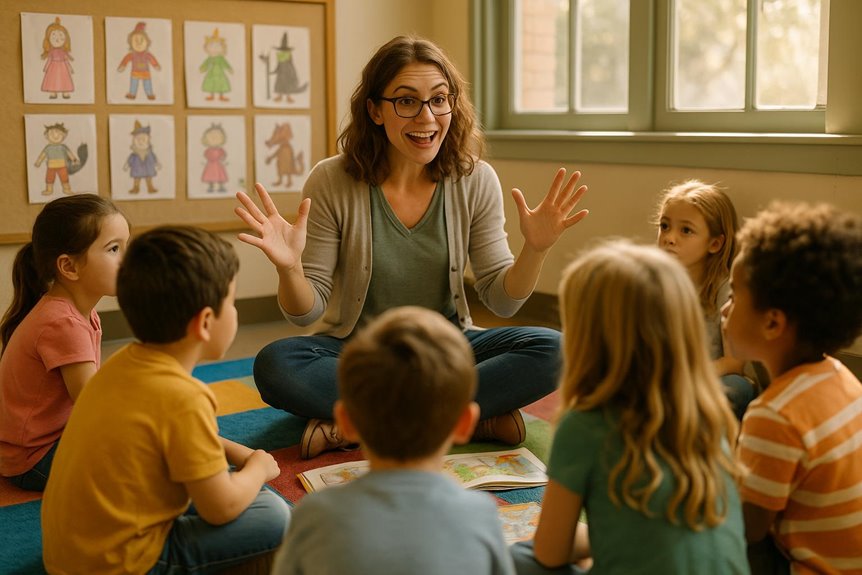
You’ve probably noticed that students who zone out during lectures suddenly lean in when you share a story. That shift isn’t random—it’s neurological. Stories activate multiple brain regions simultaneously, creating stronger memory pathways than facts alone ever could. But here’s where most teachers stumble: they treat storytelling as an occasional treat rather than a systematic teaching tool. The difference between those two approaches determines whether your students remember your lessons next month or next year.
Why Classroom Storytelling Boosts Engagement and Retention
When teachers weave stories into their lessons, they’re tapping into one of the brain’s most powerful learning mechanisms. You’ll find that storytelling techniques create emotional connections to content, making information stick in students’ minds far better than traditional methods. This approach transforms the learning process by stimulating curiosity and critical thinking, which leads to deeper comprehension of complex topics.
Your classroom becomes more dynamic when narratives drive engagement. Students participate more actively in discussions, connecting personally with the material.
When you encourage learners to share their own stories, you’re building community while bridging personal experiences with curriculum content. These relatable story elements don’t just capture attention—they deliver measurable results through higher completion rates and improved academic achievement.
Three Types of Storytelling Every Teacher Should Know
How can you harness storytelling’s power most effectively in your classroom? Start with narrative-based instruction, which uses traditional storytelling elements—characters, plot development, climax, and resolution—to convey educational concepts.
Next, try scenario-based instruction by immersing students in recreated real-world situations that enhance relevance through realistic contexts.
Finally, implement problem-based instruction, presenting challenges within narrative frameworks that engage students in collaborative problem-solving connected to real-life applications.
Each approach strengthens retention through relatable plots and strong characters. You can even incorporate digital storytelling to modernize the storytelling process while encouraging students to create their own narratives.
A well-structured approach bridges complex concepts with meaningful understanding, maintaining interest throughout the learning experience.
Aligning Story Projects With Your Learning Objectives
Understanding these storytelling approaches gives you a solid foundation, but their impact multiplies when you connect them directly to your learning objectives.
Start by identifying specific learning outcomes you want students to achieve, then select storytelling uses that naturally support these goals. When you incorporate storytelling with clearly defined themes, you’ll foster critical thinking while students explore complex concepts.
Choose diverse modalities—digital narratives, oral presentations, or written stories—to accommodate different learning styles and deepen comprehension. Connect your story projects to real-world contexts, helping students see how academic concepts apply beyond the classroom. This relevance motivates ownership of their learning.
Regularly reflect on your story selections and their effectiveness, adapting your approach to improve student engagement and outcomes.
Wonder Journals and Idea Safaris: How Students Find Stories
Every student has untapped stories waiting to be discovered in their daily lives, yet they often struggle to recognize these narrative gems hiding in plain sight.
Wonder journals serve as continuous inspiration sources where your students document observations, thoughts, and experiences that generate potential storytelling ideas. Pair these journals with idea safaris—intentional explorations of new environments where students notice unique details sparking creative opportunities.
Encourage your students to change routines: take different routes to school or explore unfamiliar campus locations for fresh perspectives.
Regular debriefing sessions after explorations let them share insights and brainstorm collaboratively. This integration emphasizes active engagement and personal investment in storytelling, strengthening students’ connection to your curriculum while developing authentic narratives rooted in their genuine experiences.
Open-Ended Themes That Spark Original Student Narratives
When you introduce themes like “In the Shadows” or “Not What You’d Expect” to your classroom, you’re offering students a creative framework without constraining their imagination.
These open-ended themes activate higher-level thinking, prompting students to forge personal connections with the material while exploring concepts through their unique interpretations.
You’ll find that storytelling becomes more engaging when students use these flexible prompts to craft narratives.
The themes provide just enough structure to guide exploration without imposing limitations on their creative expression.
This approach facilitates meaningful classroom discussions where students reflect on diverse perspectives and experiences.
Teaching Research Through Student-Led Story Investigations
How can you transform traditional research assignments into dynamic learning experiences? By empowering students to lead their own story investigations. This approach gives learners ownership of their research, enabling them to connect compelling narratives with their findings while boosting engagement.
When students analyze story elements—character perspectives, themes, and plot structures—they develop critical thinking skills directly tied to their research topics. Collaborative storytelling sessions further enhance this process through peer feedback and active participation, building community around shared subjects.
Personal narratives create emotional connections that improve memory retention and make content relatable.
Empathy Interviews: Gathering Perspectives for Richer Storytelling
Student-led investigations gain depth when researchers step beyond textbooks and online sources to engage directly with people who hold valuable knowledge and lived experiences.
Empathy interviews transform your students into active listeners who uncover historical context and personal narratives that textbooks often miss. These conversations challenge existing biases and reveal blind spots in their initial research assumptions. You’ll find students discovering surprising facts that spark deeper reflection and engagement with curriculum topics.
Through empathy interviews, your classroom storytelling becomes more inclusive and factually accurate.
Students learn to identify diverse perspectives that resonate with broader audiences. These interviews also build meaningful relationships, connecting personal and communal significance to academic research. Your students won’t just gather information—they’ll understand how individual stories contribute to collective understanding.
Should You Use Narrative or Scenario-Based Stories?
Your choice between narrative and scenario-based stories shapes how deeply students connect with curriculum content.
Narrative storytelling builds emotional engagement through clear protagonists and plots, helping learners retain information through empathy and personal connection. You’ll find this approach particularly effective when you want students to relate emotionally to complex concepts.
Scenario-based storytelling immerses learners in realistic situations requiring critical thinking and problem-solving. This method emphasizes active participation and practical knowledge application in real-world contexts, fostering collaboration among students.
Consider using storyboards for both approaches—they’ll provide visual roadmaps guiding learners through educational journeys.
Ultimately, your decision depends on learning objectives: choose narratives for emotional resonance, scenarios for contextualized problem-solving, or integrate both to maximize engagement and comprehension.
Digital Storytelling Formats: Video, Audio, and Interactive Options
While traditional storytelling relies on oral and written traditions, digital formats transform how you deliver educational narratives through technology.
Video storytelling combines visuals, animations, and sound to enhance emotional resonance and information retention.
Audio formats like podcasts create intimate engagement through narrative delivery and tone.
Interactive options, including choose-your-own-adventure and gamified narratives, promote active participation by letting learners shape story outcomes.
These digital media approaches encourage students to use creativity while developing collaboration and critical thinking skills.
When you integrate video, audio, and interactive storytelling into your curriculum, you’re providing multiple entry points for diverse learners.
Students can co-create narratives, making decisions that drive plot development and deepen their understanding of content through immersive, technology-enhanced experiences.
Storytelling Activities That Build Communication Skills
Beyond selecting the right digital format, you’ll need specific classroom activities that transform storytelling from a presentation tool into a communication workshop. Digital storytelling projects enable students to integrate writing, speaking, and visual elements simultaneously, strengthening their overall literacy.
Role-playing historical events through docudramas develops verbal communication while building empathy as students express diverse character perspectives. When students craft original myths or legends, they master narrative structures while weaving in personal or societal values, promoting critical thinking.
Peer feedback sessions enhance collaboration, teaching students to articulate constructive critiques effectively. Multimedia tools develop technical communication skills as students learn to convey messages through various formats.
These storytelling activities create authentic opportunities for students to refine communication abilities across multiple dimensions.
How to Assess Student Stories Without Crushing Creativity
Assessment becomes a delicate balancing act when you’re evaluating student stories—you need to provide meaningful feedback without dampening creative spark.
Use clear, flexible rubrics that prioritize creativity and originality while establishing expectations. Focus on core competencies like emotional engagement and theme effectiveness rather than rigid structural adherence.
Implement peer-assessment practices, allowing students to exchange feedback and reinforce collaborative learning. Encourage self-reflection so students analyze their storytelling processes, fostering ownership of creative choices.
Most importantly, provide revision opportunities based on feedback. This emphasizes that storytelling is an evolving art form, not a one-time performance.
When students understand assessment supports their growth rather than judges their stories, they’ll embrace the learning process while maintaining their unique creative voices.
Frequently Asked Questions
How Do I Integrate Storytelling in STEM Subjects Like Mathematics?
You can create word problems with narrative contexts, use historical mathematician stories to introduce concepts, develop character-based scenarios for equations, and frame lessons as mysteries students solve using mathematical reasoning and problem-solving skills.
What if Students Are Reluctant to Share Personal Stories?
You can offer alternatives like fictional scenarios, hypothetical characters, or “what if” situations. Let students create stories about imaginary people solving problems, or they’ll retell historical mathematicians’ experiences instead.
How Much Class Time Should Storytelling Activities Require Weekly?
You’ll want to dedicate 20-30 minutes weekly to storytelling activities. This duration lets you maintain engagement without overwhelming your curriculum. You can divide this into shorter sessions or one focused period, depending on your students’ needs.
Can Storytelling Work Effectively With Large Class Sizes?
Yes, you’ll find storytelling works with large classes when you use strategic techniques. You can employ small group sharing, digital platforms, student pairs, or whole-class interactive storytelling where everyone participates simultaneously.
How Do I Handle Culturally Sensitive Topics in Student Narratives?
Establish clear guidelines beforehand, create a safe sharing environment, and allow students to choose their comfort level with disclosure. You’ll need to model respectful listening, address stereotypes immediately, and provide alternative options for private sharing when necessary.
Conclusion
You’ve seen how storytelling transforms passive lessons into memorable experiences. By choosing the right format, aligning narratives with your goals, and giving students ownership of their ideas, you’ll create a classroom where curiosity thrives. Don’t let assessment stifle their voices—celebrate the process alongside the product. Start small with wonder journals or a single digital project, then watch as your students become confident storytellers who think critically, collaborate naturally, and connect deeply with every subject you teach.