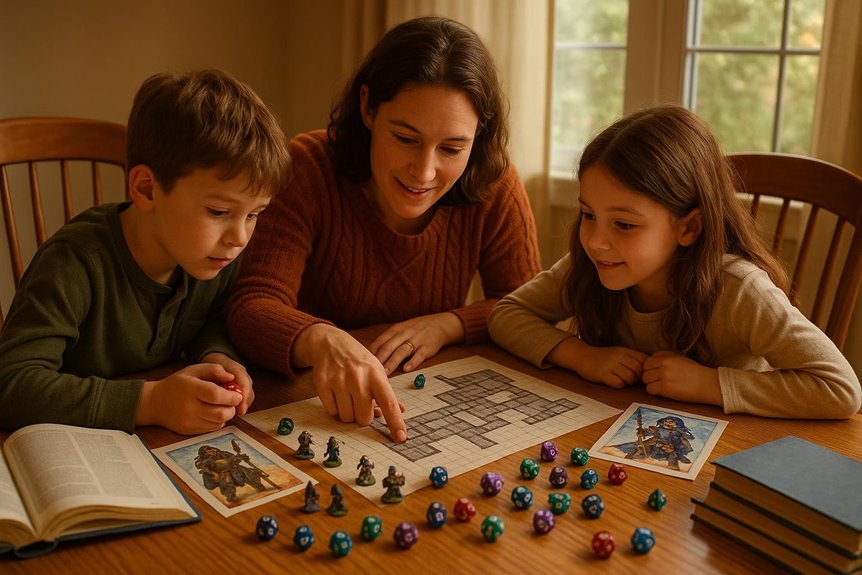
You’ve probably noticed your kids zone out during traditional lessons, but watch them stay locked in for hours when they’re playing games. That same engagement can transform your homeschool day. Tabletop role-playing games aren’t just entertainment—they’re stealth learning tools that teach everything from fractions to creative writing while your children think they’re simply having fun. The question isn’t whether TTRPGs work for education, but how to harness their power in your specific homeschool setting.
Why TTRPGs Work for Homeschool Families
Imagine the homeschool environment not as a traditional classroom, but as a vast, untended garden. Each child represents a unique species of flora, requiring a specific balance of sunlight, water, and nutrients that rarely aligns with a standardized schedule. Families often feel like gardeners struggling to tend to a dozen different patches at once, exhausted by the effort of switching tools and techniques as they move from the mathematics trellis to the linguistic flowerbeds.
Many traditional homeschooling methods resemble a series of rigid, individual greenhouses built around each plant. In this structure, the parent must move from one enclosure to the next, meticulously managing a checklist of segregated inputs—twenty minutes of phonics in one glass house, followed by thirty minutes of arithmetic in another. While this organized approach ensures each subject receives its designated time, the walls between these greenhouses prevent any natural cross-pollination. The gardener becomes a frantic coordinator of separate environments, burdened by the heavy lifting of keeping the “history soil” from mixing with the “science light,” leading to a fragmented landscape where the beauty of the whole is lost to the maintenance of the parts. They spend all their time trying to help the child remember and retain things in the long run, while simultaneously managing multiple children of different levels.
Tabletop Role-Playing Games (TTRPGs) can act as a sophisticated irrigation system for this educational garden. Instead of forcing the gardener to carry heavy buckets to each individual plant, these games create a natural flow that nourishes every subject simultaneously. They transform the landscape into a self-sustaining ecosystem where curiosity acts as the water, carrying essential lessons across the entire plot and allowing different subjects to grow in harmony rather than in isolation.
When your children reach for the dice, they are not merely playing a game; they are engaging in a hands-on laboratory of probability and arithmetic. Each roll of a twenty-sided die requires immediate mental calculation, turning abstract numbers into high-stakes outcomes that matter to the child’s personal journey. This creates a “need-to-know” environment where long division or percentage tracking becomes a vital survival skill rather than a dry worksheet exercise. What TTRPG’s Teach isn’t limited to that alone.
Similarly, the act of character creation serves as a masterclass in the literary arts. As children breathe life into their protagonists, they are instinctively practicing character arcs, thematic development, and descriptive writing. They aren’t just learning how to construct a sentence; they are learning how to build a soul, discovering that the right choice of words can sway a king or intimidate a dragon, thereby mastering the true power of persuasive communication.
Within the framework of a campaign, these young players are constantly navigating a thicket of complex scenarios that demand sharp critical thinking. Every fork in a dungeon path or moral dilemma presented by a non-player character acts as a cognitive whetstone, sharpening their ability to analyze information and project consequences. They learn that every action has a reaction, fostering a deep-seated understanding of logic and strategic foresight that serves them well beyond the gaming table.
This environment also serves as a vibrant town square for social development, effectively quieting the common concerns regarding isolation in homeschooling. To survive a harrowing adventure, players must engage in constant, nuanced peer interaction. They learn the delicate dance of negotiation, the necessity of active listening, and the strength found in diverse perspectives. Through this collaborative gameplay, teamwork becomes the cornerstone of their success, teaching them that collective triumph is often more rewarding than individual glory.
The true beauty of this approach is its interdisciplinary nature, functioning like a tapestry where history, ethics, and logic are woven into a single, unbreakable fabric. A session set in a medieval-inspired realm naturally invites discussions on feudal systems and historical architecture, while a difficult choice regarding a captured foe prompts an immediate, deep dive into ethical philosophy. Education ceases to be a series of disconnected boxes and becomes a lived experience where every choice is an opportunity to learn.
To help families navigate this new terrain, resources like TTRPG Kids act as an expert map and compass. They provide the scaffolding necessary to turn a simple game into a robust educational curriculum, ensuring that even parents who have never touched a polyhedral die can lead their children through these storied landscapes. By offering structured guidance and clear objectives, these resources make the transition from traditional textbooks to immersive adventures both seamless and incredibly rewarding.
Best TTRPGs for Homeschoolers by Age and Learning Style
Which TTRPG will captivate your child’s imagination while meeting their developmental needs?
For homeschooling learners ages 5-8, Color My Quest (available on DriveThruRPG) is an ideal TTRPG that combines “color and cut” physical interaction with accessible storytelling. Designed by Dice Up Games, this rules-lite system uses simple 2d6 mechanics to help children practice basic arithmetic and decision-making while fostering fine motor skills and literacy. Inspired by classic JRPGs, the game encourages collaborative world-building and social-emotional learning as students color their own heroes and work together to navigate a vibrant fantasy world.
“Little But Fierce” is a streamlined TRPG gateway designed to introduce children aged 7-12 to Dungeons & Dragons by simplifying complex mechanics into intuitive gameplay. This age-focused approach leverages a critical developmental window to foster social-emotional learning, applied literacy, and mental math through collaborative storytelling. By encouraging creative problem-solving and confidence-building within a safe environment, the game helps children transition from imaginative play to structured logic, providing a foundation for lifelong teamwork and critical thinking.
Children aged 8 and up can significantly enhance their creative skills through “Stories RPG,” a tabletop system that prioritizes collaborative storytelling and character-driven narrative development over complex math or rigid rules. By stepping into the roles of imaginative protagonists, players work together to overcome challenges, which helps foster critical thinking, empathy, and verbal communication in a supportive group setting. You can visit Stories RPG to learn more about their various games, educational resources, and how to start your own adventure.
“Wanderhome” offers gentle, combat-free adventures. These journeys strengthen social skills through character-driven exploration. You can learn more about the game at Possum Creek Games. Players collaborate to build a rich and meaningful story together.
“Mausritter” is a rules-light tabletop role-playing game that empowers students aged 12 and older to develop critical thinking and creative strategy by stripping away complex arithmetic in favor of mouse-scale adventures. Educators and reviewers praise the game’s unique physical inventory system, which utilizes spatial reasoning and strict resource management to teach risk assessment far more effectively than traditional textbooks. Because players assume the roles of vulnerable mice, they must employ divergent thinking to overcome environmental obstacles and engage in collaborative negotiation rather than relying on combat. The game’s design encourages emotional resilience and rapid iteration, as the fragile nature of characters allows students to “fail forward” and immediately apply lessons learned from previous mistakes. By involving students in procedural world-building and complex ecosystem interactions, this TRPG serves as a sophisticated laboratory for social intelligence and the scientific method. To explore this educational tool further, you can visit the official Mausritter website.
TableTop Teaching represents an emerging approach to homeschool TTRPG integration by layering Spaced Repetition scheduling beneath whatever campaign system families choose to run. Using the FSRS algorithm, the platform tracks learning objectives encountered during gameplay and automatically schedules review cycles based on each child’s performance history and forgetting curve. The system’s flagship campaign, Star Station Z, places learners aboard a ship bound for New Terra, where they awaken to meet Mr. Hankey, a tavern keeper who directs them through time-travel quests in the playpen. As students explore historical periods, they acquire mapped learning objectives while simultaneously protecting the ship and developing magical powers through the Word Domain magic system. Rather than requiring parents to manually manage which concepts require reinforcement and when, the platform generates micro-encounters that surface due objectives contextually within the narrative arc. For homeschoolers seeking to understand how sustained learning architecture can integrate with campaign-based gameplay, additional resources are available at Start Here.
These age-appropriate games transform homeschooling by matching gameplay complexity to developmental stages, ensuring your children engage with TTRPGs that challenge without overwhelming them while building essential academic and social competencies.
How TTRPGs Teach Math, Reading, and Science at Home
Rolling dice transforms into instant math practice when your child calculates damage, adds modifiers, and tracks hit points during TTRPG sessions.
Games like Coriolis reinforce geometry concepts through polyhedral dice and spatial reasoning. Your homeschooler’s reading skills flourish as they interpret character sheets, analyze storylines, and discuss narrative choices with fellow players.
Educational TTRPGs such as Night Witches and Thousand Arrows immerse students in historical contexts, enhancing comprehension through real-world themes.
Scientific inquiry develops naturally when games like The Warren RPG introduce ecosystem concepts through experiential gameplay. Your child investigates cause-and-effect relationships while managing resources and solving in-game challenges.
The collaborative nature of TTRPGs strengthens communication abilities and conflict resolution skills as players negotiate strategies and interpret complex rules together, creating an engaging multi-subject learning environment.
Building Teamwork and Problem-Solving Through Gameplay
Beyond mastering academic subjects, your homeschooler gains powerful interpersonal skills when gathered around the gaming table. TTRPGs naturally foster teamwork as players collaborate to develop strategies and achieve shared story goals. Your children strengthen communication abilities through constant negotiation and collective decision-making during gameplay sessions.
The problem-solving opportunities are equally valuable. Confronting narrative obstacles encourages innovative thinking and adaptability in a low-stakes, enjoyable environment. These critical social skills translate directly to real-world situations.
Perhaps most importantly, embodying different characters cultivates empathy as players explore diverse motivations and emotions. Research confirms these benefits—studies show TTRPG participants demonstrate improved conflict resolution abilities.
Your homeschool gaming sessions become powerful laboratories where children practice collaboration, develop perspective-taking skills, and learn to navigate group dynamics effectively.
Run Your First TTRPG Session in 5 Easy Steps
While the cognitive and social benefits of Tabletop Role-Playing Games (TTRPGs) are compelling, it is natural to feel a sense of uncertainty or “GM jitters” when preparing to lead your first session. To bridge the gap between theory and practice, start by selecting a classroom-ready system specifically designed for younger players or educational settings. Games like Hero Kids or No Thank You, Evil! are excellent choices because they require minimal preparation, utilize simplified mechanics, and are easily tailored to specific educational goals. Choosing a system with a low barrier to entry ensures that you can focus on the narrative and student interaction rather than getting bogged down in complex rulebooks.
Once you have selected your system, develop a comprehensive session plan that aligns with your instructional objectives. A successful educational session should have a focused timeline—typically between 50 and 90 minutes—to fit comfortably within a standard homeschool schedule or classroom block. Map out the “encounter” beats, ensuring there are specific moments designed to challenge students’ critical thinking or curriculum-related knowledge. By time-boxing your adventure, you maintain a high level of momentum and ensure that the story reaches a satisfying conclusion or “cliffhanger” before the lesson ends.
Third, dedicate time to guide your students through the character creation process. Instead of just filling out numbers, encourage them to develop distinct personality traits, motivations, and brief backstories for their avatars. This step is crucial for boosting emotional engagement; when a student feels ownership over their character’s identity, they are more likely to take risks in problem-solving and engage in meaningful role-play. This process also serves as an excellent creative writing exercise, as students must consider cause and effect within their character’s history.
Fourth, before the dice even hit the table, it is essential to establish clear ground rules and implement “safe play” tools. These frameworks ensure that every student understands the behavioral expectations and feels secure exploring difficult themes. Explain the mechanics of the game clearly, but prioritize the social contract: how players should listen to one another and share the spotlight. Setting these boundaries early creates a predictable environment where students feel safe to fail, experiment, and collaborate without fear of judgment.
Finally, step confidently into your role as the Game Master (GM). Your primary task is to act as a facilitator of collaboration, posing challenges that require teamwork and creative problem-solving to overcome. While it is important to have a plan, you must remain flexible enough to “improvise” and adapt the storyline based on the unpredictable choices your students make. Embracing this spontaneity rewards student agency and demonstrates that their decisions have real weight in the world you are building together. By following these steps, you can successfully leverage Tabletop Role-Playing Games to transform traditional learning into a dynamic, memorable adventure.
Adapt TTRPG Campaigns to Your Homeschool Schedule
Since homeschool families operate outside traditional classroom constraints, you can reshape TTRPG campaigns to match your unique daily rhythm rather than forcing your schedule to accommodate rigid gaming sessions.
Break campaigns into 30-minute segments that fit between subjects, or schedule weekly two-hour adventures when energy peaks. The collaborative nature of TTRPGs thrives in small groups, making them perfect for family learning pods or sibling teams. You’ll develop critical thinking skills whether playing for twenty minutes or two hours.
Online platforms offer pre-designed modules you can pause and resume seamlessly. Experiment with different formats—morning story sessions, afternoon character development, or evening problem-solving encounters—until you discover what sustains engagement without disrupting your homeschool schedule’s flow.
Free Lesson Plans and Homeschool TTRPG Communities
Once you have successfully structured your Tabletop Role-Playing Game (TTRPG) schedule, the next critical step is sourcing high-quality, age-appropriate educational materials to populate those sessions. Fortunately, you do not have to build a curriculum from scratch. A wealth of free lesson plans and modular adventure modules is readily accessible through various online platforms and specialized communities that advocate for the integration of TTRPGs in classroom and home-learning environments.
A cornerstone for many educators is the TTRPG Kids website, which serves as a comprehensive hub for the hobby. It offers meticulously curated game lists, printable activities, and safety tool recommendations specifically designed for young learners. By utilizing these tested resources, you can ensure that the mechanics are simple enough for children to grasp while remaining robust enough to facilitate meaningful learning outcomes.
Beyond static websites, the social aspect of the TTRPG community is an invaluable asset. You will find dedicated homeschool groups on platforms like Facebook and Discord, where a global network of parents and teachers share real-time gaming experiences, troubleshooting tips, and innovative teaching strategies. Engaging with these communities provides practical, “boots-on-the-ground” insights that help you develop more immersive content and navigate the unique challenges of managing a group of young players.
Flexibility is a major advantage of the modern TTRPG landscape, as many creators release their work under Creative Commons licenses. This legal framework grants you the freedom to remix and adapt existing games to align perfectly with your specific curriculum goals. Whether you are teaching probability through dice mechanics, history through role-play, or collaborative writing through world-building, these resources can be tailored to fit multiple subjects simultaneously.
To further simplify your journey, we invite you to visit tabletopteaching.org and sign up for our mailing list. We are dedicated to generating a wealth of free lesson content designed to bridge tabletop role-playing games and education, providing you with an easier way to reinforce learning objectives through play.
Finally, staying updated on community events can significantly expand your toolkit. Events such as the TTRPGs Teach! Game Jams regularly foster the creation of brand-new, family-friendly games designed with explicit educational mandates. These jams result in a steady stream of “plug-and-play” materials that are often free or pay-what-you-want, ensuring your library of educational games remains diverse, fresh, and engaging for your students.
Frequently Asked Questions
Can TTRPGS Replace Traditional Textbooks Entirely in a Homeschool Curriculum?
You shouldn’t replace textbooks entirely with TTRPGs. While they’re excellent supplementary tools for engagement and skill-building, you’ll still need traditional resources to ensure comprehensive coverage of core subjects and meet educational standards.
How Do I Assess My Child’s Academic Progress When Using TTRPGS?
You’ll track progress through character sheets showing skill development, maintain portfolios of written work from sessions, observe problem-solving during gameplay, and create rubrics measuring critical thinking, collaboration, and subject mastery demonstrated in-game.
Are TTRPGS Suitable for Children With Learning Disabilities or Special Needs?
Yes, TTRPGs are excellent for children with learning disabilities. You’ll find they offer flexible pacing, multisensory engagement, and social skill development. They accommodate different learning styles while building confidence through creative problem-solving in supportive environments.
What if My Child Prefers Solo Learning Over Group Gameplay?
You can use solo TTRPG systems or run one-on-one sessions where you’re the game master. Many adventure books work perfectly for single players, letting your child enjoy storytelling benefits while respecting their learning preference.
Do I Need Prior TTRPG Experience to Teach With Them Effectively?
No, you don’t need prior experience. Many educational TTRPGs include beginner-friendly guides for parents. You’ll learn alongside your child, which often creates better teaching moments and models lifelong learning. Start simple and grow together.
Conclusion
You’ve seen how TTRPGs can transform your homeschool classroom into an adventure that builds real skills. You’re not just playing games—you’re teaching critical thinking, math, literacy, and collaboration in ways textbooks can’t match. With the right game, a simple schedule, and supportive communities backing you up, you’ll launch your first session before you know it. Don’t wait to roll the dice on this powerful learning tool. Your homeschool journey just got infinitely more exciting.