
The Texas Education Freedom Accounts application portal opened on February 4, 2026, and parents across the state are now staring at a six-week window to submit their applications. If you're one of them, you've probably already felt the familiar knot of deadline anxiety: Should I apply right now? What if I wait too long? What if I mess something up?
Here's the first thing you need to know, and it changes everything: this is not a race.
Unlike most government programs, TEFA applications aren't processed first-come, first-served. Every application submitted between now and March 17 at 11:59 p.m. gets reviewed together, after the portal closes. That means clicking "submit" at 9:01 a.m. on February 4 gives you the exact same chance as submitting at 11:58 p.m. on March 17.
That design choice matters. It means you can take a breath, gather your documents, and actually understand what you're applying for before you hit send.

The Timeline That Actually Matters
Here's how the next few months will unfold:
February 4 – March 17, 2026: Application window is open. The entire process takes 10–20 minutes once you have your documents ready.
Early April 2026: Funding notifications go out. If you're approved, you'll know by the first week of April.
June 1, 2026: Initial deadline to select a participating school (if you're going the private school route).
July 1, 2026: The first installment: 25% of your total award: becomes available. This is when you can start purchasing curriculum, paying tuition, or covering other approved expenses.
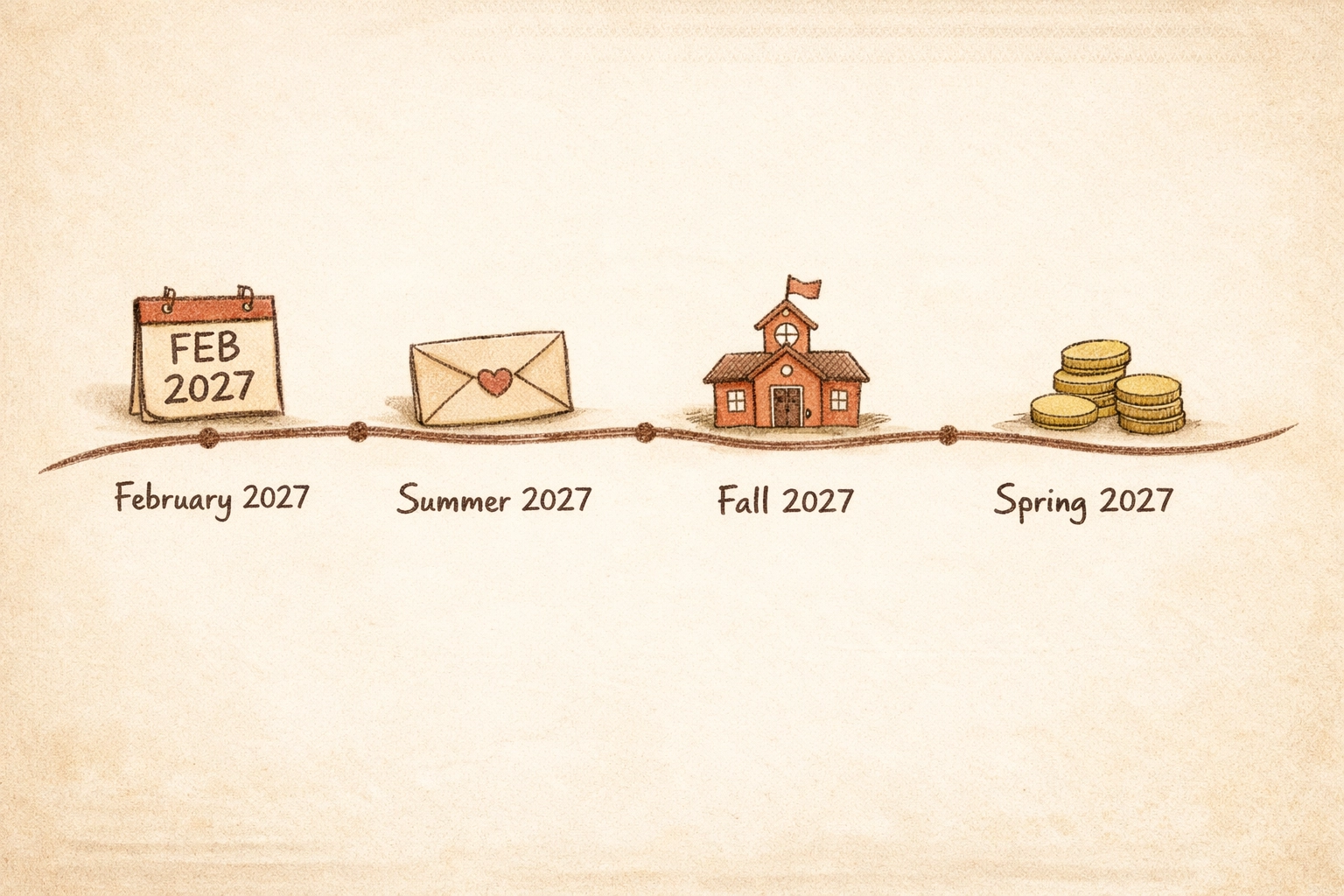
October 1, 2026 and February/Spring 2027: Additional funding installments are released throughout the school year.
The structure is deliberate. That July payment is designed to help families handle upfront costs: registration fees, curriculum purchases, first-quarter tuition: without needing to float thousands of dollars while waiting for reimbursement.
Who Gets Priority (And What That Really Means)
Texas has set two priority categories for TEFA funding:
- Low-income families (based on 2025 tax returns)
- Students with disabilities (documented with an IEP on file with your local district)
If your child has an active IEP and your household income falls below the state's threshold, you're in the highest priority group. But "priority" doesn't mean other families won't receive funding: it means the state reviews those applications first and allocates resources accordingly.
This is especially important for families navigating special education services. If your child has an IEP, that's not just a priority marker: it also unlocks higher funding. Students with documented disabilities can receive up to $30,000 annually, compared to the standard $10,474 for private school students or $2,000 for homeschoolers.
What You're Actually Getting
Let's break down the funding structure:
Private School Students: $10,474 per year
Homeschool Students: $2,000 per year
Students with IEPs: Up to $30,000 per year (depending on the services outlined in their IEP)
These aren't lump-sum payments. The money is distributed in quarterly installments:
- 25% on July 1 (to cover upfront costs)
- Additional installments in October, February, and Spring
There's one notable restriction: only 10% of your total award can be spent on technology. That means if you receive $10,474, you can allocate about $1,047 to laptops, tablets, or software. Everything else needs to go toward tuition, curriculum, therapies, or other approved educational expenses.
The cap makes sense from a policy perspective: Texas wants to fund education, not subsidize electronics purchases. But it's a constraint worth knowing about if you were planning to invest heavily in adaptive technology or specialized software.
What You Need Before You Apply
The application itself takes 10–20 minutes. The real work happens before you click "start."
Here's what you'll need to gather:
Proof of Texas Residency: Driver's license, state ID, utility bill, lease agreement, mortgage statement, voter registration card, or a notarized affidavit.
Tax Documentation: Your 2025 tax returns (to verify household income).
Social Security Information: Your SSN or ITIN, plus your child's SSN.
IEP Documentation (if applicable): If your child has an Individualized Education Program, it must be on file with the Texas Education Agency. You'll need to reference it in your application.
Educational Intent: You'll declare whether your child will attend private school or homeschool, but you don't need to name a specific school yet. That decision can wait until June.
The last point is worth emphasizing. Many parents assume they need to have everything locked in: school selected, curriculum purchased, schedule mapped out: before applying. That's not the case. You're declaring intent, not committing to a specific plan. The real decision-making happens after you're approved.

The Strategic Approach: What to Do Right Now
If you're reading this on February 5, here's a reasonable plan:
Week 1 (Now through February 11): Gather documents. Pull your 2025 tax returns, locate your Texas ID, confirm your child's SSN is correct. If your child has an IEP, call your local district and verify it's on file with TEA.
Week 2-4 (February 12 – March 3): Research your options. Visit the list of 1,500+ approved private schools, explore homeschool curriculum options, and start thinking about what educational model fits your family. You're not committing yet: you're just building a mental map of what's possible.
Week 5 (March 4 – March 10): Submit your application. By this point, you've done your homework. You know what you need, you have your documents ready, and you can complete the application without rushing.
Week 6 (March 11 – March 17): Backup week. If something went wrong: missing document, technical issue, unexpected question: you still have time to fix it.
This timeline assumes you're starting fresh. If you already know your child will attend a specific private school and you have all your paperwork organized, you can apply today. But if you're still figuring things out, you have time to make informed decisions.
What Happens After You Submit
Once the March 17 deadline passes, Odyssey: the New York-based company administering TEFA: will review all applications together. That review process takes about two weeks. By early April, you'll receive a notification: approved, waitlisted, or denied.
If you're approved, you'll have until June 1 to select a participating school (if you're going the private school route). If you're homeschooling, you'll confirm your intent and start planning your curriculum purchases.
On July 1, the first 25% of your funding becomes available. This is when the program shifts from abstract policy to real dollars in a restricted-use account. You can pay tuition, purchase curriculum, cover therapy costs, or reimburse yourself for approved educational expenses.
The quarterly installments continue throughout the school year. By the time spring 2027 arrives, you'll have received your full award: assuming you've met the program's requirements and documented your spending correctly.

The Bigger Picture: Why This Design Matters
Texas structured TEFA differently than many other Education Savings Account (ESA) programs. The non-competitive application window, the priority system, the quarterly installments: these aren't arbitrary choices. They're designed to reduce chaos, prioritize families with the greatest need, and prevent the kind of mad rush that crashes servers and rewards whoever happens to be online at 9:00 a.m. on launch day.
Does it create uncertainty? Yes. You won't know if you're approved until April. But it also creates fairness. A single parent working two jobs has the same chance of approval as a family with the flexibility to apply the moment the portal opens.
That's worth the wait.
What to Do Next
If you're planning to apply for TEFA, start gathering your documents this week. If you're still deciding whether this program makes sense for your family, read through our detailed TEFA breakdown and check out our step-by-step application checklist.
And if you're exploring homeschool curriculum options: especially methods that keep kids engaged without requiring you to become a full-time teacher: join the Adventure waitlist. We're building tools designed to make education feel less like a second job and more like something your family actually wants to do.
The TEFA application window is open until March 17. You have time. Use it.
Explore More Texas Homeschool Resources:
View all State Guides →
Disclaimer: Adult/guardian supervision is required for all Tabletop Teaching activities. The content provided on this site is designed to support educational exploration and is not a substitute for professional medical, psychological, or educational advice. Always consult with qualified professionals regarding your child's specific needs. Information about programs like TEFA is based on publicly available sources and aims to inform families: it does not guarantee eligibility or outcomes.